Annual Internet Service Provider Review 2026
Google Fiber holds its throne, T-Mobile joins the speed club, and Optimum gives customers the best deal in years.

Mar 26, 2026 | Share 


Annual Review, Data and Research, Featured

Every year, HighSpeedInternet.com compares the nation’s largest internet providers according to what matters most to customers: price, speed, reliability, and customer experience. Using millions of proprietary and public data points, we conduct our annual review with the goal to empower you with highly relevant and actionable information so you can choose the best internet service for your home.
In this review:
How we compare | Best overall | Fastest ISP | Best Value | Most Reliable | Customer’s Choice | Final call
In this review:
How we compare providers
Our Annual Internet Service Provider Review uses both proprietary and public data sets to compare internet service providers (ISPs). These data sets include performance test results from the HighSpeedInternet.com speed test, internet plan and pricing data from our Internet Plan Index, customer feedback from our annual customer survey, and ISP network coverage data from the Federal Communications Commission (FCC).
Speed test data
The HighSpeedInternet.com speed test collects performance data on thousands of internet providers, averaging 6-8 million unique tests per year. At the end of the year, we use this data to calculate average and median speeds, latency, and jitter for each ISP.
Internet Plan Index
We track internet plan pricing, details, and policies for all the major internet providers in the country in our Internet Plan Index. In addition to hands-on research, we keep this database as accurate as possible with information provided by the ISPs themselves.
Customer Satisfaction Survey
Our Annual Customer Satisfaction Survey gathers feedback from thousands of customers. This independent and unbiased survey is conducted and analyzed via a third party. We received feedback from 10,000 internet customers.
Changes to the 2026 review
As the internet landscape continues to evolve and our data resources and priorities shift, we adjust our methodology accordingly to provide you with the most accurate, relevant, and actionable information possible.
This year, we’ve based our reliability scoring 100% on customer reviews and feedback. While we do have data available on outages and reliability, these data sets are often too vague or hyper-specific to certain regions. This change affects only our reliability measurement and does not impact other parts of the review.
Best Overall: Google Fiber
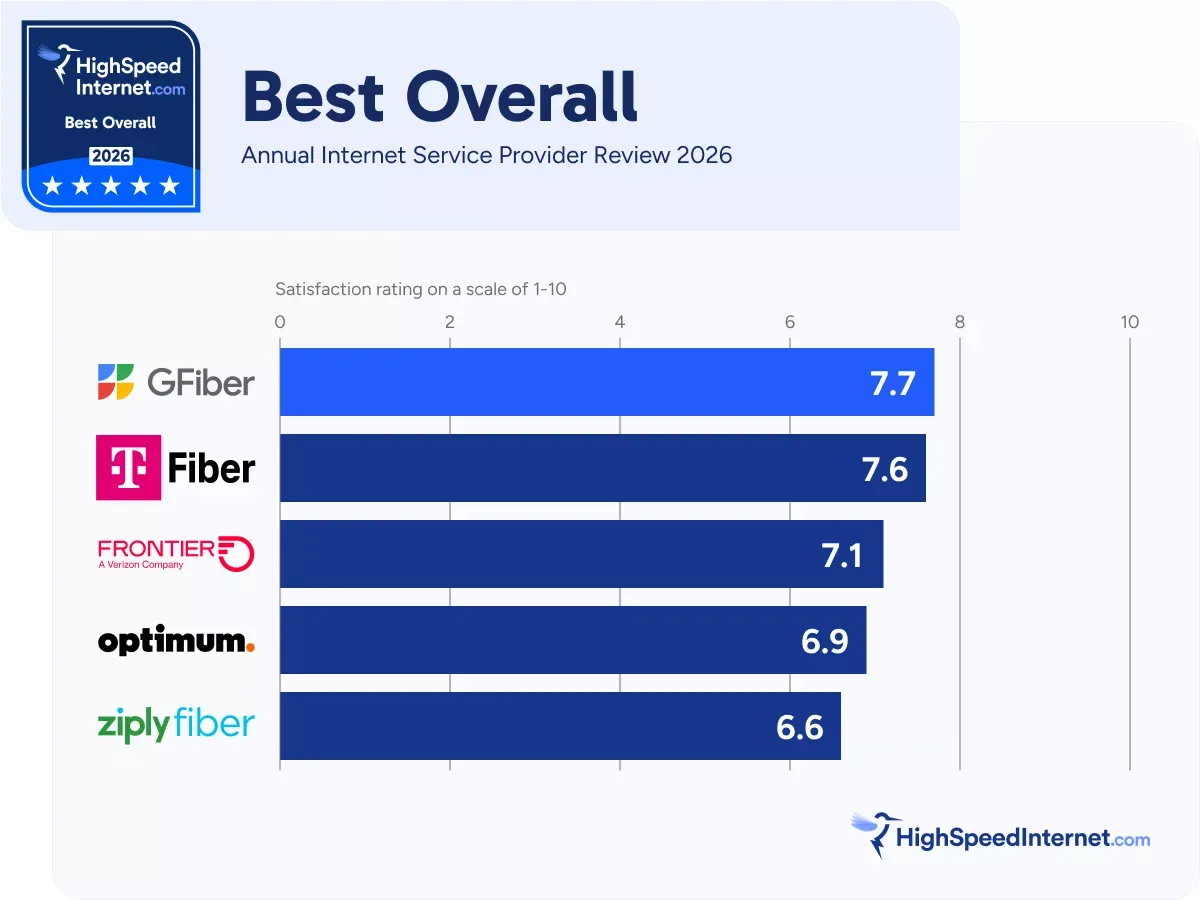
Google Fiber has the Best Overall internet for another year. Image by Kayla Fischer | HighSpeedInternet.com
The consistent excellence of Google Fiber cannot be overstated, as it triumphs as the nation’s top internet provider for the third year in a row. Its services deliver uncompromising performance. Its reliability is second to none. Its unrivaled customer feedback attests to its honest and straightforward policies and management. Google Fiber sets the bar for quality internet and gives customers a service they can truly count on.
Google Fiber is always fast and improving. So we weren’t surprised by its phenomenal 287Mbps average speeds this year, making it one of the country’s fastest ISPs, yet again. Google Fiber’s network consistently produces positive customer feedback, usually the best customer feedback we see all year. In 2026, Google Fiber customers again rated their experiences exceptionally high in every category.
But something deeper in the data did manage to surprise us, something that proves Google Fiber’s excellence isn’t dependent on its technology or even its second-to-none fiber-optic network, but upon its core mission.
Google Fiber’s fixed wireless service, called Google Fiber Webpass, received equally amazing customer feedback as its fiber internet service. From a technology perspective, we’d expect weaker performance from Google Fiber Webpass than its fiber to the home (FTTH) services in just about every way. Fixed wireless uses cell-tower transmissions that cannot stand toe-to-toe with wired connections like fiber and cable. The technology is simply not as capable.
So why are Google Fiber Webpass customers just as happy with their services, speeds, and customer experience? Webpass customers even gave a higher reliability score than the fiber-optic customers. To be completely honest, we don’t fully understand how. Our only explanation is that this provider is committed to delivering the best internet experience, regardless of the network.
Google Fiber’s top-notch experience transcends the tech; it comes from the drive, accountability, and reliable excellence of the company itself.
Fastest ISP: T-Mobile Fiber
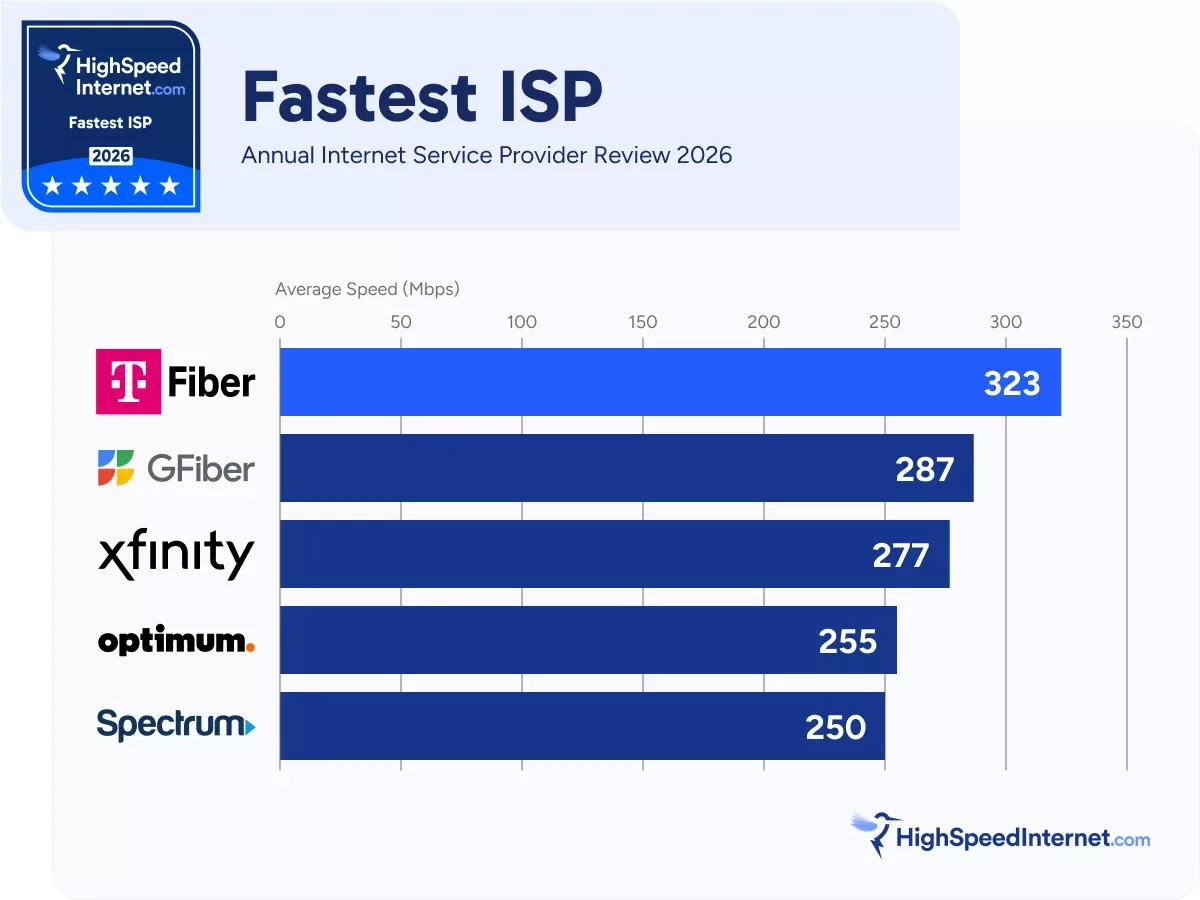
T-Mobile’s average speed is 36Mbps faster than the next competitor. Image by Kayla Fischer | HighSpeedInternet.com
T-Mobile completely shattered our speed record with an insane 323Mbps average speed. That number comes from an analysis of over 5 million speed tests backed by confirmation from an even larger public speed test data set. Both said the same thing: T-Mobile is the fastest internet provider in America.
T-Mobile streamed past the competition by an enormous margin. The top ISP speeds are usually separated by 10 or 15Mbps. This time, it’s not even close, with the nearest competitor clocking in at 287Mbps, a full 36Mbps slower. Measuring T-Mobile’s speeds in 2026 means dramatically resetting the bar of what it means to be America’s fastest internet provider. Why? Because T-Mobile Fiber’s average speeds are much faster than anyone could have predicted and dramatically faster than anything we reported last year or the year before that!
T-Mobile knocked the doors down with its debut into home internet service. T-Mobile 5G Home Internet shattered multiple norms with an extremely affordable plan that did away with common pain points internet customers had been tolerating for years, resulting in some of the most favorable customer feedback we had ever seen. T-Mobile is now aggressively expanding its reach into the fiber market, with its recent acquisitions of Lumos and Metronet, granting it over 8 million customers as of Q3 2025.
We are excited to see T-Mobile make the jump to a sizable national fiber provider. When T-Mobile shook things up with 5G home internet, it permanently made the internet market a friendlier place for customers. We’re hoping to see the same results from T-Mobile’s fiber endeavors. In fact, with these speed test results, one could argue we already have.
Best Value: Optimum
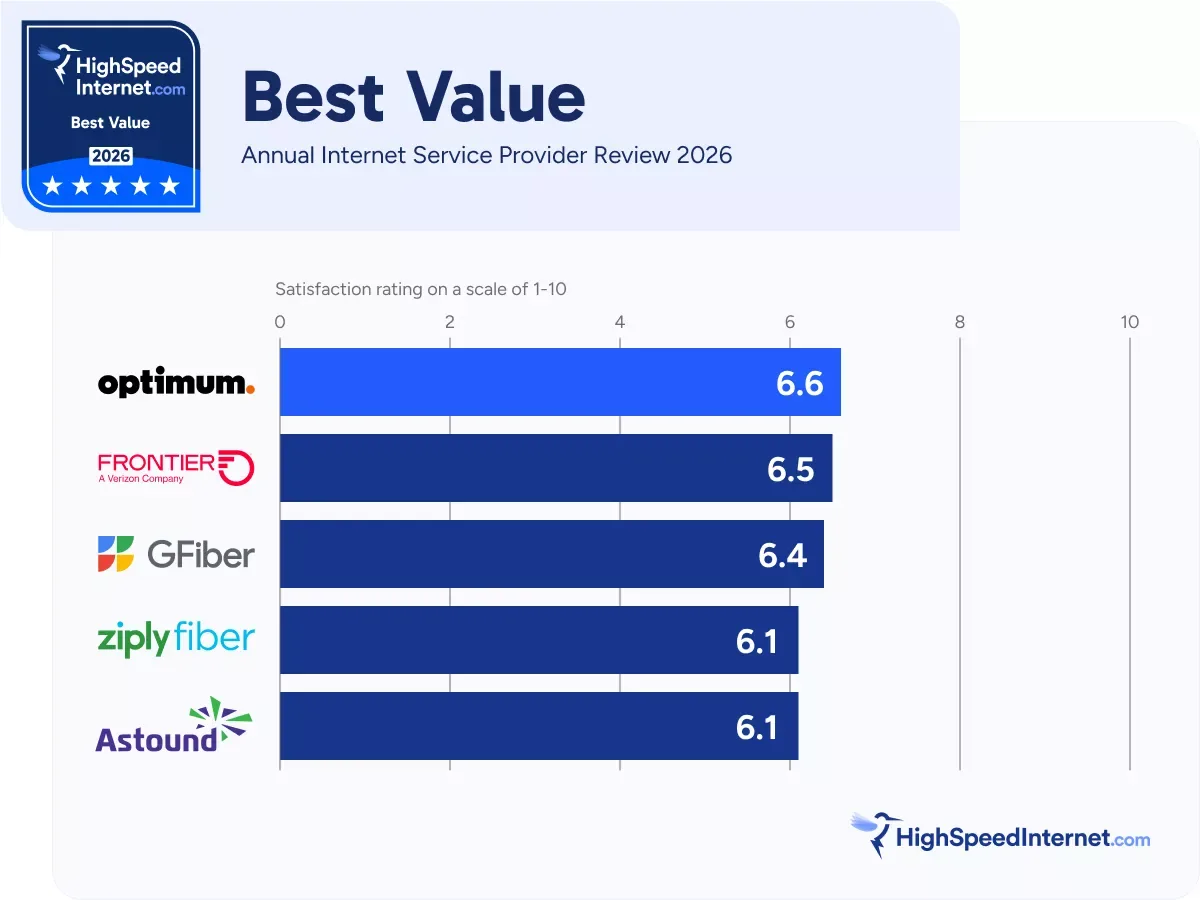
Customers reported favorably on Optimum’s low-priced plans. Image by Kayla Fischer | HighSpeedInternet.com
Optimum knows that the best way to win over internet customers is to be kind to their wallets. And accordingly, it has priced its powerful internet plans lower than any other ISP. This is a simple success story: Optimum delivers fast and complete internet plans for extremely low rates. For what you get, Optimum provides internet service at prices so low that we had to make sure we were reading the data right.
Optimum’s 500Mbps internet plan, which can come from either a cable or fiber connection, is priced at only $30 per month. Let’s say that again: $30 monthly for 500Mbps speeds. That’s essentially the perfect internet plan for a family of four, especially when you consider that it comes with unlimited data, no contracts, potentially symmetrical speeds, and, typically, a five-year rate lock. This is no one-off either; the whole plan roster looks like that: gig plans for $50, a screaming 5Gbps for $75, and even more budget-friendly plans starting at $25.
In today’s expensive world, we consider any internet plan $50 and below to be budget-friendly. Optimum gave us a hold-my-beer moment and sliced that number right in half with its $25 rates. We may need to reassess what we expect out of internet pricing going forward as Optimum resets the standard.
Most Reliable: Google Fiber
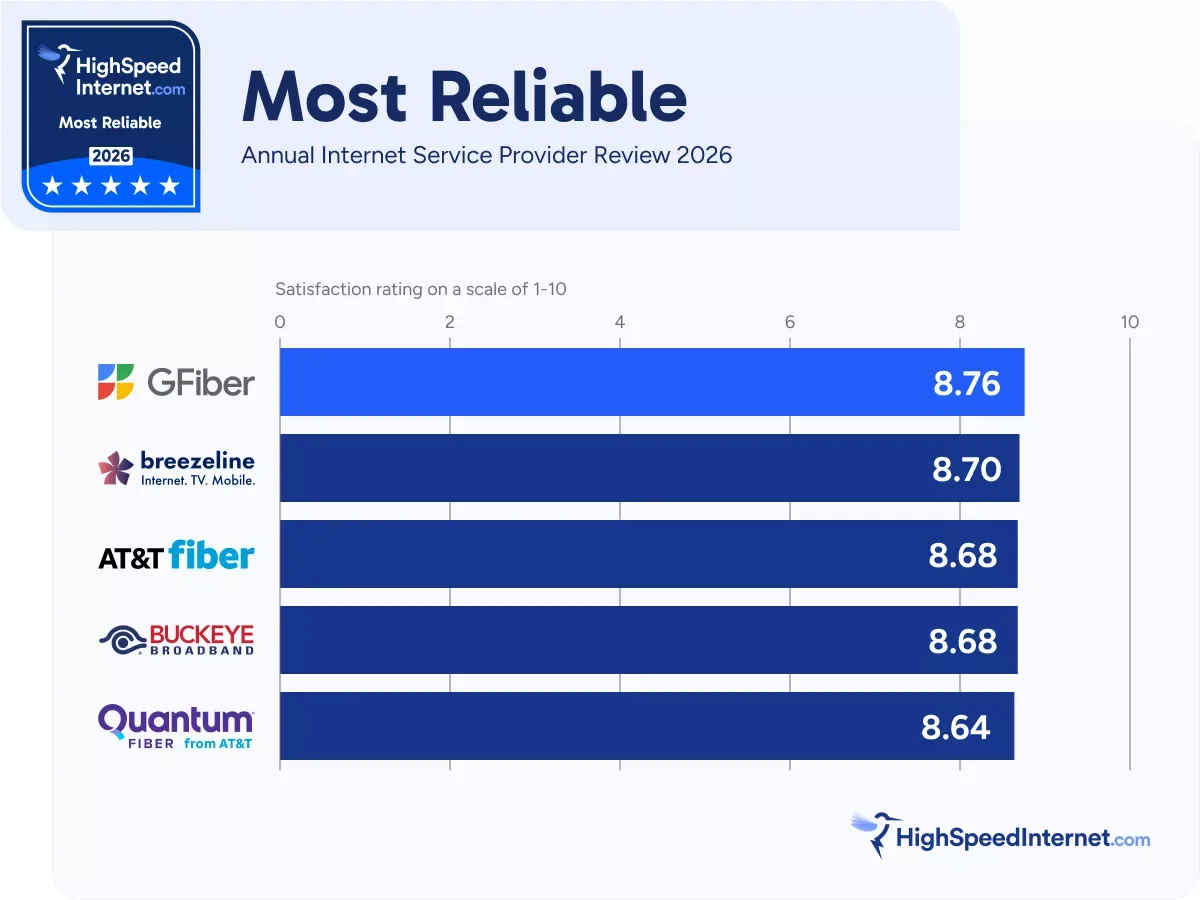
Google Fiber takes a strong lead in reliability. Image by Kayla Fischer | HighSpeedInternet.com
This isn’t the first time Google Fiber customers have placed the ISP on top for reliability, as it earned the same claim in 2024. This is likely due to Google Fiber’s above-and-beyond standards in all aspects of its service. It isn’t surprising that its network design and maintenance fly above the competition. Google Fiber goes to great lengths to provide the following network advantages:
- 99.9% uptime: Customers should experience less than nine hours of downtime a year, even when factoring in power outages, line problems, and scheduled maintenance in addition to internet outages.
- Core fiber backbone with multiple layers of redundancy: Think of this like an internet highway with several fast alternate routes to use in times of heavy traffic or “lane” closures.
- Localized caching and peering of data: Google Fiber uses various network strategies to get data to your home faster.
- Network maintenance and operations that employ a customer-first mindset: Google Fiber prioritizes customer experience when organizing network construction, upgrades, and maintenance.
Customer’s Choice: Google Fiber
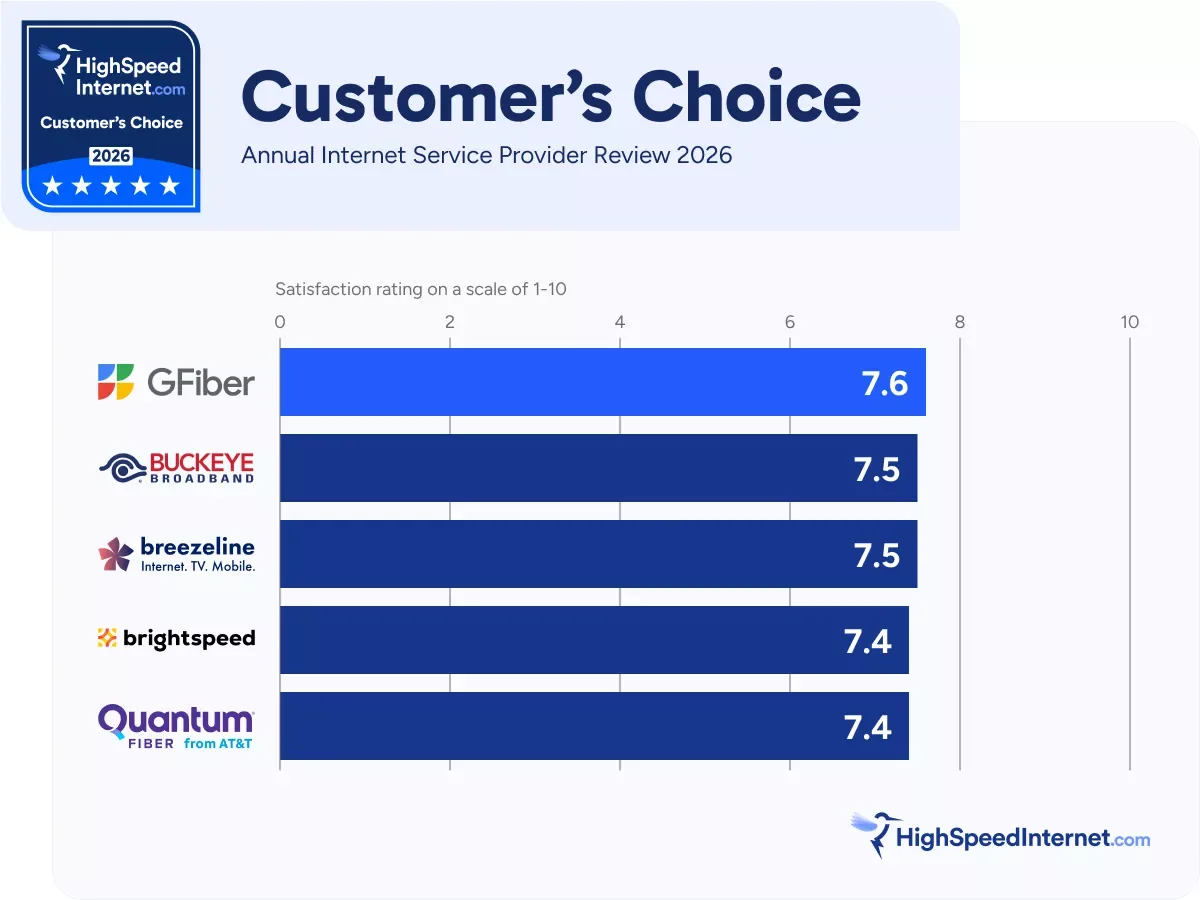
Google Fiber’s customer-first policies secure it another win. Image by Kayla Fischer | HighSpeedInternet.com
Why are customers choosing Google Fiber as their favorite? Taking home Best Overall, Most Reliable, and Customer’s Choice this year isn’t an accident. Even when Google Fiber doesn’t win in a category, it comes very close. It was our runner-up on Fastest ISP and came within two-tenths of a point for Best Value! All of these are inputs into gaining customer trust and advocacy. Clearly, its product is making customers happy, and this is why customers are choosing Google Fiber as their favorite over any other internet service provider.
Final call: It’s an internet customer’s market in 2026
Last year, we saw more and more ISPs finally giving in to what customers have been demanding for decades: cheaper plans. At the same time, internet providers can’t get away with substandard service. With just about every aspect of our lives touching the internet in some way, customers would high-tail it just as fast from slow speeds and spotty Wi-Fi as they do overpriced internet packages.
The result is that providers are delivering better internet performance while bringing prices down at the same time. There’s no doubt that technological improvements in nearly every service type have helped providers streamline their operations.
Perks aren’t special, but expected
Not too long ago, you may have expected to be locked into a contract, have a limiting data cap, and get a mystery fee or two on your internet bill. But today, there’s an ISP in just about every region offering a path away from these pain points; a trend that’s turning these customer perks into customer essentials.
Thankfully, the overall increase in affordable internet plans we saw in 2025 has continued to the present, and we are seeing even more providers drop contract requirements and data caps, which improves the value of any internet plan.
When sizing up internet providers, we get a chance to see which are axing these dated customs for more sensible approaches that align with the times. We’re happy to say that more providers have chosen the paths of unlimited data, no contracts, longer rate locks, and fewer fees than ever before.
Fiber continues to reign supreme
Fiber internet has widened the performance gap even further between its cable competitors. We had high hopes for cable in 2024, when Cox achieved the fastest speeds in the nation on its cable network. We even thought that DOCSIS 4.0 might level the field against fiber’s light transmissions. Cable speeds have improved, but they are still well slower than fiber.
The great T-Mobile takeover
Will T-Mobile rise to the top of all categories next year? It’s certainly possible! T-Mobile’s first foray into home internet service showed us that it could pull off a major shift to the market in a very short time. With T-Mobile now making a major fiber play with the fastest speeds already in the bag, the sky is the limit.
Author - Austin Aguirre
Austin worked as a broadband technician installing and troubleshooting countless home internet networks for some of the largest ISPs in the U.S. He became a freelance writer in 2020 specializing in software guides. After graduating with a BS in technical communication from Arizona State University, he joined the team at HighSpeedInternet.com where he focuses on home network improvement and troubleshooting.
Editor - Jessica Brooksby
Jessica loves bringing her passion for the written word and her love of tech into one space at HighSpeedInternet.com. She works with the team’s writers to revise strong, user-focused content so every reader can find the tech that works for them. Jessica has a bachelor’s degree in English from Utah Valley University and seven years of creative and editorial experience. Outside of work, she spends her time gaming, reading, painting, and buying an excessive amount of Legend of Zelda merchandise.
Related Posts