Fiber vs. Cable Internet for Business
Choose the right connection for your business needs
Mar 13, 2026 | Share 


Business
Sarah is part of HighSpeedInternet.com‘s business editorial team. All reviews are created using provider-sourced data and verified by industry-trained researchers to ensure accuracy.
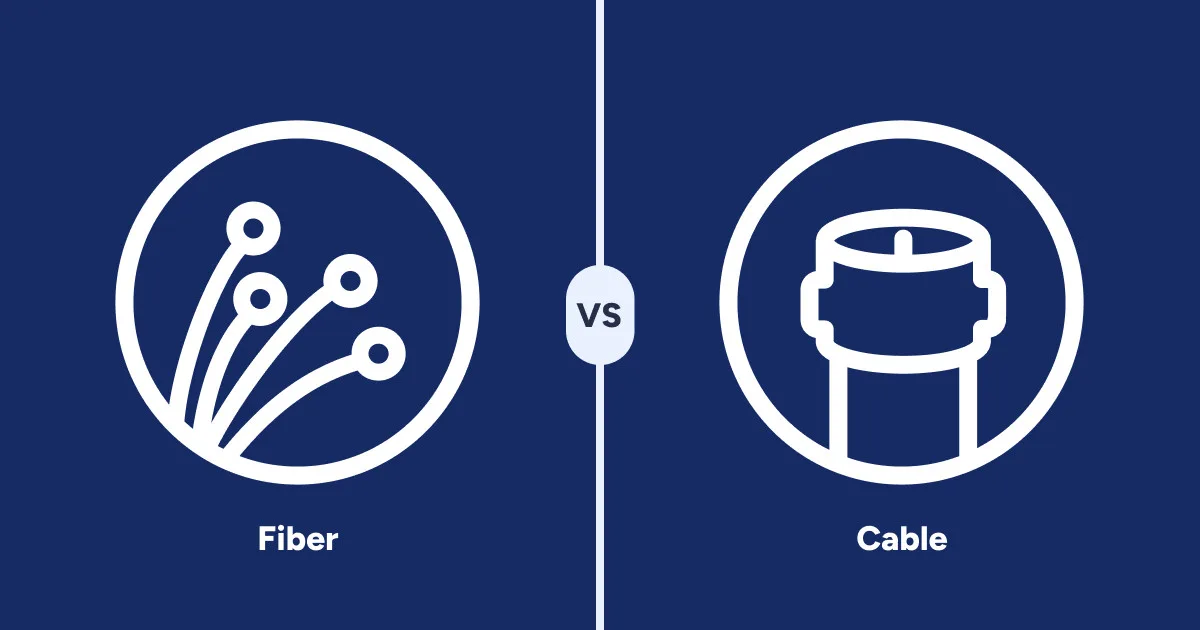
When it comes to business internet, faster isn’t always better. Fiber internet might beat out cable on speed, but each connection type has its unique advantages. And yes, there are times when paying less for slower speeds is the better business choice.
Here are the pros and cons of each:
Fiber pros
 Fast, symmetrical speeds
Low latency and high reliability
Capacity for many users and devices
Cable pros
Wide availability
Lower costs with easier installs
Strong speeds for most business needs
Fiber cons
 Limited availability
Higher startup cost
Professional installation requirements
Cable cons
Slower upload speeds
Variable performance during congestion
Limited potential for long-term upgrades
Fiber internet is an excellent solution for multi-location businesses and large worksites that need fast speeds and increased bandwidth for dozens of employees and devices.
Cable internet is more than capable of handling daily operations for most small businesses, including video calls, file uploads, cloud tools, and many other modern business activities. It’s also more widely available than fiber, so it’s easily accessible for most businesses.
The option that’s best for your business internet isn’t always a clear choice. This guide helps make it easier by exploring the benefits of fiber and cable business internet and explaining which businesses should use which type of connection.
Fiber vs. cable: Choosing the right internet for your business
High-performance fiber connections are enticing because who doesn’t want the fastest connection possible? But fiber really isn’t necessary for all businesses, and it can mean overspending on performance you don’t use. It’s also not available in all locations, which limits who can access fiber.
Even though fiber is lauded as the fastest connection, cable still offers very fast, reliable, and widespread connections for businesses of many sizes.
Let’s break down the main features for each type of connection:
| Feature | Fiber internet | Cable internet |
|---|---|---|
| Connection type | Fiber-optic cables using light signals | Coaxial cables |
| Typical speeds | 300–10,000Mbps | 100–2,000Mbps |
| Upload speeds | Symmetrical (upload = download) | Slower than download speeds |
| Reliability | Very reliable with minimal signal interference | Reliable, but can slow during peak network congestion |
| Availability | Limited in rural areas due to fiber build-out | Widely available across most cities and suburbs |
| Pricing | Often higher, especially for multi-gig plans | Typically lower starting prices |
| Installation | Typically requires professional installation | Often available with self-install options |
| Best for | Data-heavy businesses, cloud platforms, large teams, VoIP | Small to midsize teams, retail shops, offices with moderate internet use |
Learn more about the internet needs for small businesses and internet needs for large enterprises.
When fiber is the best for business internet
Fiber is the best internet solution for businesses that send and receive large files, host multiple video calls at once, support large teams in a single location, connect multiple locations together, or need to give remote workers access to centralized tools and data.
There are a few reasons fiber business internet could be your best option:
- Higher maximum speeds: Supports multi-gigabit speeds for high-bandwidth operations.
- High-capacity bandwidth: Handles many users uploading and downloading data at once, without slowdowns.
- Symmetrical speeds: Equal upload and download speeds allow for large file uploads, cloud backups, and frequent video calls.
- Consistent performance: Network congestion experiences fewer slowdowns during peak traffic times.
- Built for scale: Offers room to grow with your business.
- Lower latency: Supports video calls, Voice over Internet Protocol (VoIP), and remote desktops.
Shared fiber is becoming more affordable as costs go down, so the main drawback of fiber is availability. Internet service providers (ISPs) are still expanding their fiber networks to reach more business locations.
Ready to look for fiber internet?
Enter your zip code to see fiber plans near you.
When cable internet is better for business
For many small businesses, cable’s speeds and stability can support all of their internet needs. It’s also widely available in most parts of the U.S.
There are a few reasons cable internet could be better for your business:
- Widespread availability: Cable is available in metropolitan, suburban, and rural areas.
- Easier installation: Most buildings are already wired.
- Lower starting cost: You’ll often find lower entry-level pricing than fiber.
- Bundled services: Internet can be bundled with business TV, phone service, or mobile plans.
Fiber vs. cable for daily work
Beyond just speed, there are some differences between how cable and fiber connections function. Depending on your business needs, those differences can either create issues or go unnoticed during a typical workday.
Fiber
Shared fiber connections can experience slowdowns during peak usage times, but fiber networks typically offer significantly more bandwidth than cable, so congestion is less common, and slowdowns are usually less noticeable. Even during busier periods, many businesses can continue running normal operations without interruption.
Fiber also offers Dedicated Internet Access (DIA), which eliminates the headaches of network congestion. DIA is a high-tier, more expensive service than shared fiber, but it’s a good option for businesses that depend on an uninterrupted internet connection.
Fiber also offers symmetrical upload and download speeds, which allow businesses to upload large files, run video calls, and use cloud applications more efficiently. For companies doing time-critical or data-heavy work, fiber is often the most reliable choice.
Cable
It’s not uncommon for cable connections to get slower during peak usage times on the network, typically morning hours and evenings. Your cable internet traffic goes through a shared connection with traffic from all other customers on the network. As more users access the network, congestion builds, and it can cause slowdowns.
That congestion will be more apparent for businesses that deal with a lot of data-heavy and real-time activities. At peak congestion times, you might see stuttery video calls, slow file transfers, and even slower web browsing and email loading.
On the other hand, small businesses with just a few devices connected to their network, such as one or two point of sale terminals, a small security system, and a few tablets, will be less likely to notice congestion slowdowns.
Fiber vs. cable costs
ISPs have been making their fiber prices more and more competitive, so it’s possible to find cable and fiber plans with similar monthly service rates.
However, between installation and equipment fees, fiber is still going to be more expensive at the start of service.
Fiber
Fiber offers high-performance internet access, but it can come at a price. Upfront costs are often higher than cable because most new fiber connections require professional installation. Equipment for fiber connections can also be more costly than cable, either upfront or as a monthly rental fee.
Fiber can be more expensive than other options due to several reasons:
- Monthly service costs: You might pay a bit more per month compared to standard cable, but you’re paying for the extra speed.
- Upfront setup costs: Fiber installation requires specialized tools, so professional installation is always required.
- Equipment costs: Fiber requires an optical network terminal, which can increase your upfront costs.
Cable
Cable offers the best of both worlds: strong performance for most business needs, fast setup, and lower-cost plans. While cable has its speed limitations, it’s still a solid option for most small to midsized businesses.
Cable can be less expensive than fiber for a few reasons:
- Minimal installation: Many locations already have cable lines installed, meaning you don’t need to pay for an extensive installation.
- Plug-and-play equipment: Self-installation kits make setup a breeze. No technician required.
- Standard equipment: Required hardware is common and relatively inexpensive.
The right connection for your business comes down to cost versus performance. When performance can’t be compromised, fiber is the winner. If you want to save on costs while still getting a business-capable connection, cable is a strong option.

Look for cable business internet plans in your area
Enter your zip code to see all providers near you.
Fiber vs. cable business use cases
Restaurants, retail, hospitality, and offices all have different internet needs, so business size alone doesn’t give you a full picture when choosing between fiber or cable.
Let’s explore some real-world situations where each connection makes the most sense.
Fiber
Healthcare providers, financial services, tech companies, and call centers are just a few types of businesses that benefit the most from fiber, as they tend to need more bandwidth. You don’t want to worry about hiccups in your network when processing financial transactions, transferring patient data, or supporting dozens of customer calls.
Fiber offers the speeds and stability for dozens of connected devices at once, including:
- Multiple point-of-sale terminals
- Equipment monitoring
- Security systems
- Inventory systems
- TVs for streaming content
- Reservation and table management
- Tablets for tableside ordering
- Time clocks
- Handheld payment terminals
- Multiple Internet of Things sensors
In the end, the right choice comes down to how much bandwidth your daily operations require.
Cable
Single-location offices, boutique retail, cafes, and small restaurants don’t necessarily need the performance of fiber, and can easily manage their operations with cable business internet.
Cable speeds are more than enough to handle common business internet activities, including:
- Cloud tools
- VoIP
- Processing payments at a single point-of-sale terminal
- Occasional video calls
- Small security system
- Internet browsing and email
Key takeaways and next steps
- Fiber offers the fastest speeds, but upfront and monthly costs can be higher.
- Fiber offers dedicated connections that keep traffic separate on the network to maintain consistent speeds.
- Fiber is best for data-heavy, multi-location, rapidly growing, and large businesses.
- Cable offers fast and stable connections, and can cost less than fiber overall.
- Cable can support many modern business activities, including video calls and cloud tools.
- Cable is great for small and medium-sized businesses.
Get even more guidance on choosing between fiber and cable business internet by connecting with one of our U.S.-based experts, for free.
HighSpeedInternet.com partnered with Clearlink Consulting to provide guidance and help businesses find the connectivity solution that best fits their day-to-day operations.
Clearlink Consulting is an independent technology consulting firm, not a service provider. Their live agents listen to your needs and help guide you to the right business internet solution.
Call +1-833-923-6262 to get connected with a live, local agent for free.
Author -
Editor - Jessica Brooksby
Jessica loves bringing her passion for the written word and her love of tech into one space at HighSpeedInternet.com. She works with the team’s writers to revise strong, user-focused content so every reader can find the tech that works for them. Jessica has a bachelor’s degree in English from Utah Valley University and seven years of creative and editorial experience. Outside of work, she spends her time gaming, reading, painting, and buying an excessive amount of Legend of Zelda merchandise.
Related Posts