How Does Starlink Internet Work?
Starlink has overhauled the satellite internet industry with low-Earth orbit satellites

Mar 12, 2026 | Share 


Brand Guides, Technology
Starlink isn’t the oldest player in the satellite internet world, but it has quickly become the largest, and the way Starlink operates is unlike any other satellite internet provider we’ve seen. Starlink’s unique low-Earth orbit (LEO) approach to satellite internet, with faster speeds and lower latency, leaves traditional geostationary satellite internet providers behind.
Starlink has transformed the global satellite internet space and operates the largest satellite constellation in the world, but how exactly has Starlink managed to completely overhaul the industry? Let’s dive into what makes Starlink’s satellite internet unique and how it’s transforming the satellite internet market.
In this explainer:
Starlink’s LEO approach to satellite internet | Starlink space infrastructure | Starlink ground infrastructure | Starlink’s continual growth and potential global mobile coverage
In this explainer:
Starlink’s LEO approach to satellite internet
Traditional geosynchronous orbit (GSO) satellites and their most important subset, geostationary (GEO) orbit satellites, are synchronized with the Earth’s rotation, so it takes them an entire day to fully travel around the world. These satellites are large and can provide coverage for large regions, but take a lot of fuel for satellites to go this far into orbit. Providers like Viasat use these types of satellites. GEO satellites orbit the Earth at an altitude of around 35,786 km, while Starlink satellites orbit at about 550 km—almost 65 times closer.
In contrast, Starlink frequently launches LEO satellites into space that are then used to create a constellation of satellites. Since these satellites are in a lower orbit, they can provide customers with faster internet speeds and lower latency.
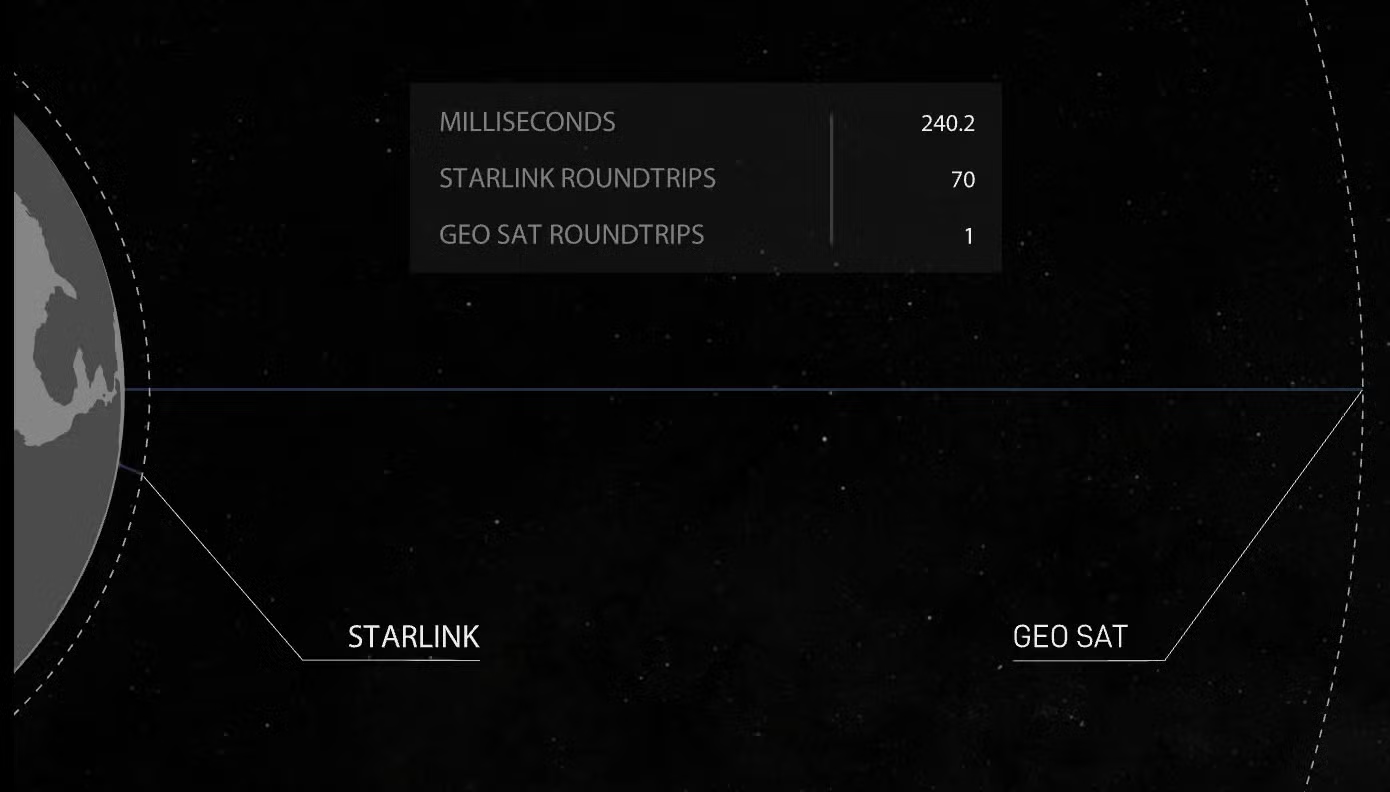
The time it takes for data to travel back and forth between Starlink’s satellites and the Earth is a lot shorter compared to GEO satellites, leading to an astonishingly lower latency of anywhere as low as 25 to 60 milliseconds compared to the usual 600+ milliseconds from other satellite internet providers. That’s an insane 90% decrease in latency. With changes like the reduction of latency it’s easy to see how Starlink has transformed the satellite internet world.

Want to see what Starlink speeds are available in your area?
Enter your zip code below to check out all Starlink plans and prices available to you.
Starlink space infrastructure
Technically, Starlink is owned by Space Exploration Technologies Corporation, and while the space infrastructure is owned by SpaceX, there is dedicated space infrastructure deployed for Starlink. Once satellites are launched, they are deployed into orbit and form part of a satellite constellation. Starlink’s satellite constellation is the largest in the world and is operated by SpaceX.
SpaceX doesn’t only produce its own satellites for Starlink; it has the ability to launch its own satellites and operates its own spacecrafts, making it easier and faster to scale—so it’s no surprise it’s quickly become the largest satellite constellation. Let’s discuss Starlink’s satellites, equipment, and how the infrastructure works both in space and on Earth.
Starlink’s satellites
Starlink’s satellites communicate with user terminals on the ground using advanced phased array antennas. Starlink has launched a few generations of satellites, but the most modern satellites use optical space lasers to communicate with other satellites. With this technology, there’s less of a need for ground stations in every region Starlink operates—pretty impressive, right?
Starlink’s satellites are lighter and smaller compared to traditional GEO satellites, so more satellites can be launched and deployed at once. Starlink’s satellites have a flat design that allows them to be stacked to maximize launch trips.
Optical space lasers
Starlink’s satellites are all equipped with three space lasers each, also known as optical intersatellite links or ISLs. These lasers create a worldwide internet mesh throughout Starlink’s constellation that currently supports user download speeds of up to 400Mbps.
Starlink’s satellites have lots of notable features that allow them to provide the speed and decreased latency customers enjoy.
Antennas and star trackers
Each Starlink V2 satellite uses a total of eight antennas, specifically five Ku-band, and three Ka-band and E-band antennas for you satellite nerds who might be curious. These antennas provide high-bandwidth connections for Starlink customers.
SpaceX also has custom-built star tracking navigation sensors—which sound like something out of a sci-fi movie, but we promise it’s real. These sensors use the stars to determine the location, orientation, and altitude of each individual satellite and are mainly used to prevent collisions.
Starlink ground infrastructure
In order to connect to Starlink’s satellite in space, customers use a Starlink satellite dish, a Wi-Fi router, and power cables. Starlink’s satellite dishes are relatively easy to set up and automatically self-align towards the sky to receive the strongest signals possible.
There are hundreds of SpaceX ground stations that connect Starlink satellites to the internet. Starlink users don’t need to have their dish within a line-of-sight of a ground station because data is transmitted between satellites via lasers.
SpaceX ground stations
SpaceX has hundreds of ground stations, also known as gateways, that create physical connections to the satellite network in space and the internet network on Earth. SpaceX’s ground stations physically plug into fiber-optic lines on Earth and are used to process data to customers. Here’s a quick overview of the path data follows when connecting to Starlink’s satellites.
- A customer’s Starlink dish sends a signal to a Starlink satellite in space.
- The Starlink satellite relays that signal down to a SpaceX ground station.
- The ground station fetches data from the internet through fiber-optic lines.
- The process is reversed to send data back to customers.
There are hundreds of ground stations operated by SpaceX, but they’re not publicly listed so it’s hard to find an exact number. FCC filings l include an approximate count of ground stations, and according to early 2026 filings, SpaceX has the largest satellite ground network in history. There are over 100 ground sites in the U.S., with anywhere from 6 to 50 sites in Europe, Australia, Canada, South America, and New Zealand.
Starlink’s continual growth
Before Starlink came into the satellite internet world, online activities like streaming, gaming, or video calls were almost impossible for some rural users. Now, Starlink offers low-latency internet plans with speeds up to 400Mbps that make these activities possible on a satellite connection.
Starlink satellite launches occur every few days, and its satellite constellation continues to grow rapidly. Starlink’s speeds have gradually gotten faster, and equipment prices have also dropped since launch, making it relatively more affordable and accessible. Starlink’s satellite internet has constantly evolved and will continue to change how satellite internet is used around the world.
Author - Andrea GutierrezPrieto
After graduating from the University of Utah with an honors degree in Linguistics, Andrea Gutierrez Prieto transitioned from being an Analytic Linguist and Research Assistant to the HighSpeedInternet.com team. Andrea has a background in academic and research writing with a passion for helping readers make informed decisions. Off the clock, Andrea spends her time watching anime, reading manga, and baking delicious pastries at home.
Editor - Jessica Brooksby
Jessica loves bringing her passion for the written word and her love of tech into one space at HighSpeedInternet.com. She works with the team’s writers to revise strong, user-focused content so every reader can find the tech that works for them. Jessica has a bachelor’s degree in English from Utah Valley University and seven years of creative and editorial experience. Outside of work, she spends her time gaming, reading, painting, and buying an excessive amount of Legend of Zelda merchandise.
Related Posts