FBI Cybercrime Data Reveals Unique Challenges for D.C., Alaska, and Wyoming
A state-by-state analysis of surging cybercrime stats in America
Dec 10, 2025 | Share 


Data and Research, Industry Exclusive/Entertainment, Trends
We might assume that cybercrime mostly happens in big-city tech hubs—places packed with high-value targets, major tech companies, and digital infrastructure. However, the FBI’s latest Internet Crime Complaint Center (IC3) report shows a much more varied, diverse picture of how Americans across the board face the threat of cybercrime.
 What is cybercrime?
Cybercrime can be defined as criminal activity that involves digital devices like computers, smartphones, tablets, etc—or computer and communications networks (websites, emails, chatrooms, etc)—for illegal activities such as theft, fraud, or impersonation or false representation. These can come in the form of advance-fee schemes, hacking, employment and opportunity schemes, ransomware and data breaches.
Americans filed over 859,000 cybercrime complaints nationwide, reporting more than $16.6 billion in losses—a 33% increase from the year before.
When you break down the data by state and adjust for population (with estimates from the U.S. Census Bureau), the usual suspects don’t always top the charts. Instead, we see places like Alaska, Wyoming, and D.C. that face the highest per-capita losses and complaint rates.
And while D.C. reports the nation’s highest financial losses per capita at $41.5 million per 100,000 residents, it files only half as many complaints as Alaska, which leads the country with 914.7 reports per 100,000 people. So what explains that discrepancy?
The answer reveals that cybercrime doesn’t hit every state the same way—some face targeted, high-dollar attacks, while others deal with widespread, lower-value scams.
A quick look at the FBI’s IC3 data’s state-by-state analysis
 D.C. leads in financial losses: $41.5 million per 100,000 (over 12 times the national average of $3.4 million) with average losses of $75k per complaint (three times the national average).
 Alaska leads the nation in complaints: 914.7 per 100,000 residents (nearly four times the national average of 210 per 100,000).
Wyoming and Nevada rank in the top five for per-capita losses despite having two of the smallest state populations in the U.S.
Alaska reports the most complaints but not the biggest losses: The state’s high complaint rate doesn’t reflect high-dollar crimes, suggesting more widespread, lower-value scams compared to the targeted attacks hitting D.C. and Wyoming.
The states that lose the most to cybercrime
D.C. stands alone at the top for cybercrime, far and above any other state. The nation’s capital reports a staggering $41.5 million in cybercrime losses for every 100,000 residents, roughly five times higher than the second-place state. We can’t say for certain, but the concentration of high-net-worth targets (government officials, political entities, tech firms, etc) likely plays a role.
Nevada comes in second at $8.2 million per 100,000, followed by Wyoming at $7.4 million. It’s a striking contrast: A state known for tourism and gambling next to one of the least densely populated states in the country.
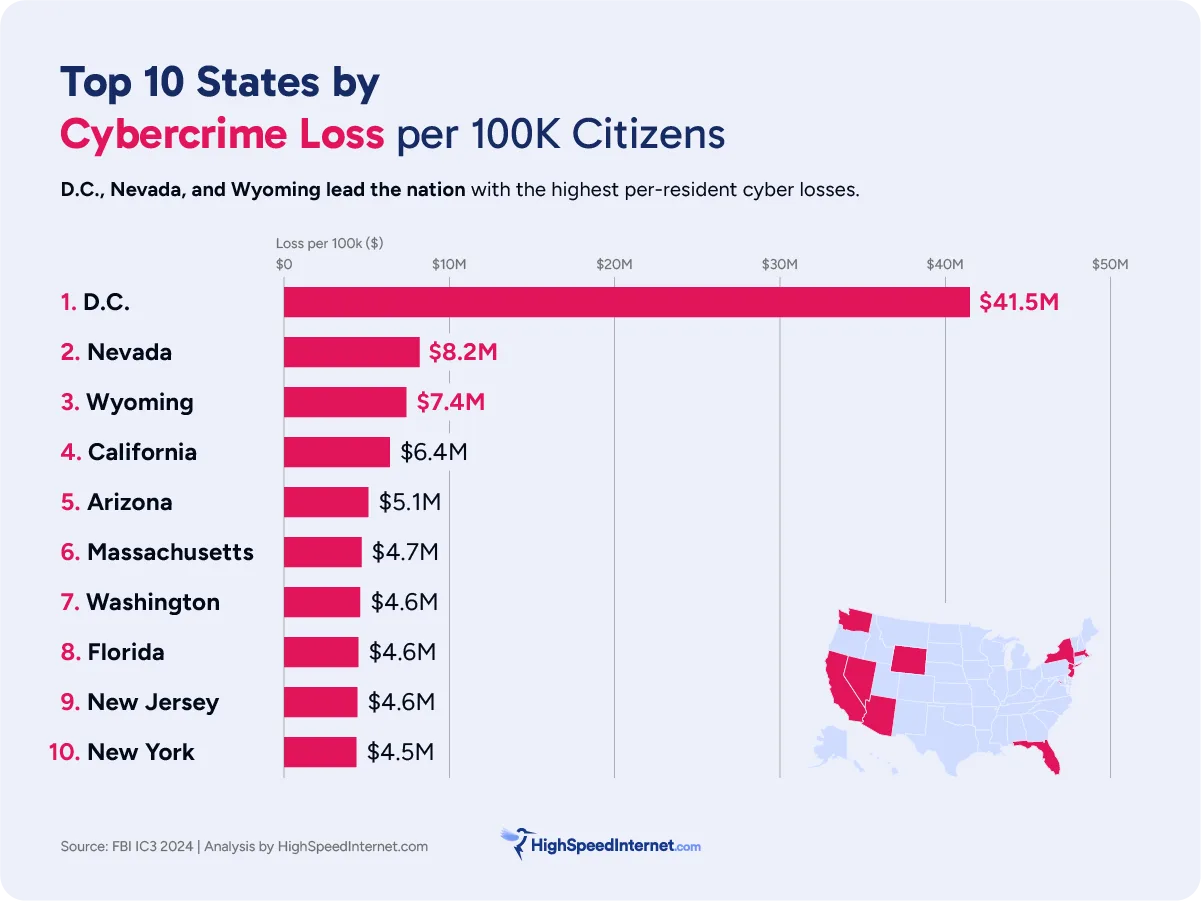
California, Arizona, and Massachusetts round out the top six, each reporting between $4.7 million and $6.4 million in losses per capita.
Top 10 states by cybercrime loss per 100,000 citizens
| Rank | State | Loss per 100k citizens |
|---|---|---|
| 1 | District of Columbia | $41,513,914 |
| 2 | Nevada | $8,225,617 |
| 3 | Wyoming | $7,403,235 |
| 4 | California | $6,439,159 |
| 5 | Arizona | $5,175,704 |
| 6 | Massachusetts | $4,748,658 |
| 7 | Washington | $4,626,726 |
| 8 | Florida | $4,586,256 |
| 9 | New Jersey | $4,577,026 |
| 10 | New York | $4,550,077 |
Western states (California, Washington, Arizona, and Nevada) and Eastern states (D.C., Massachusetts, Florida, New Jersey, and New York) dominate the top ten, while America’s interior states report lower losses per capita. Whether that’s about tech adoption, population density, or reporting rates is unclear. Let’s dig into the data around complaints reported to get a better understanding.
Even smaller states face big cybercrime problems
Though D.C. tops the charts for financial losses, it drops to second place for complaint volume, suggesting that when cybercrime hits the capital, they’re seeking high-value targets.
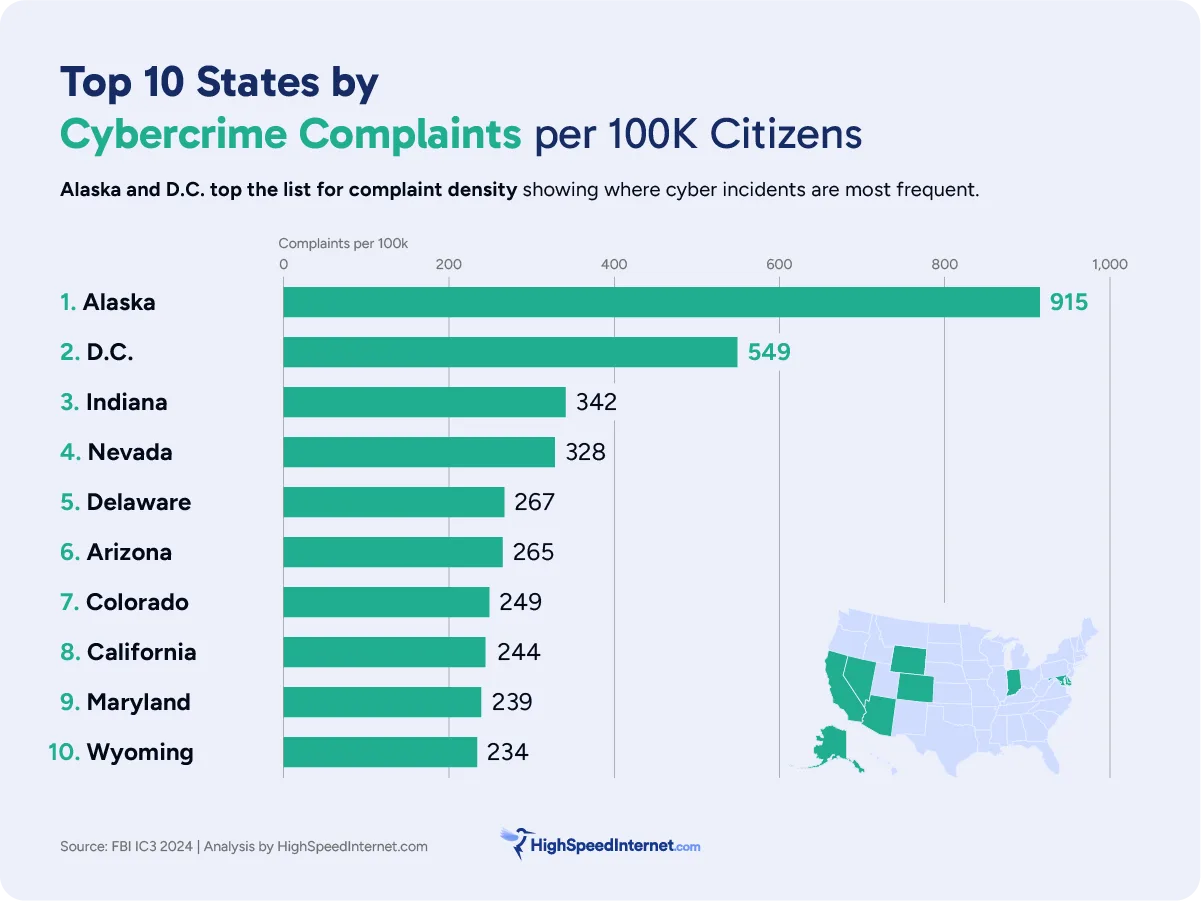
However, Alaska leads the nation in cybercrime complaints by a wide margin, with 914.7 reports per 100,000 residents—nearly doubling D.C.’s 549.1 reports per capita. Which raises questions about what makes America’s largest and most remote state stand out for cybercrime complaints: Is it a matter of actual higher crime rates, more vigilant reporting, or something about Alaska’s unique connectivity challenges and isolated communities?
Top 10 States by Cybercrime Complaints per 100,000 Citizens
| Rank | State | Complaints per 100k |
|---|---|---|
| 1 | Alaska | 914.7 |
| 2 | District of Columbia | 549.1 |
| 3 | Indiana | 341.7 |
| 4 | Nevada | 328 |
| 5 | Delaware | 266.8 |
| 6 | Arizona | 265.1 |
| 7 | Colorado | 249.2 |
| 8 | California | 244.1 |
| 9 | Maryland | 239.4 |
| 10 | Wyoming | 234.3 |
Notably, several high-loss states also have higher complaint reporting rates, such as Nevada, Arizona, California, and Wyoming, but the order has shifted considerably. So what happens when we look at the average loss per complaint? That’s where the story becomes clearer.
Do high cybercrime losses match the number of complaints reported?
By highlighting the highest losses per complaint, or where each reported incident costs the most, we can see that the impact and distribution of cybercrime vary widely from state to state, regardless of population and geography.
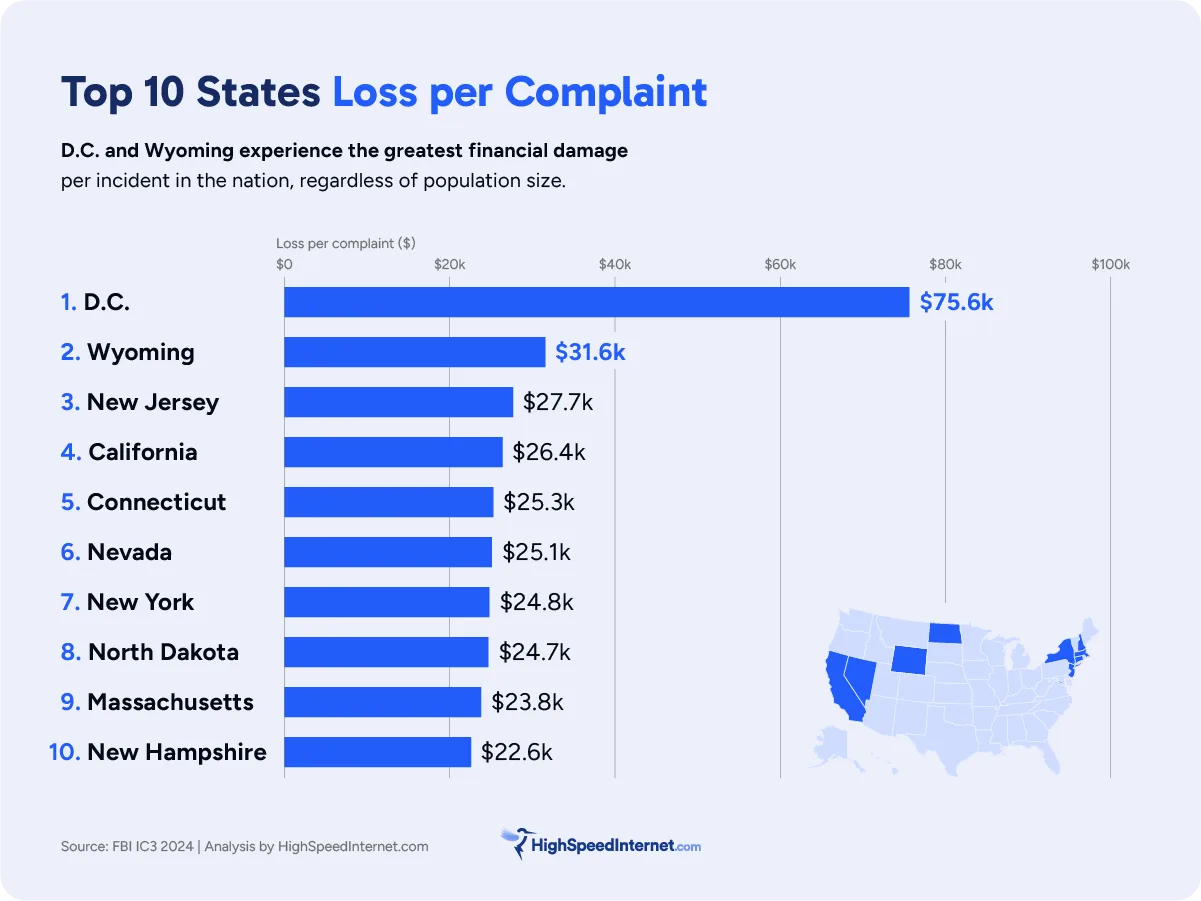
Alaska, with by far the highest number of complaints, is absent from the top 10 of losses per complaint. In other words, the losses aren’t nearly as high-value as they are elsewhere, implying a lot more smaller-value crimes.
“Smaller communities are increasingly being targeted because attackers know victims there often lack cybersecurity support.”
– Bryan Vorndran, Assistant Director of the FBI’s Cyber Division.
Top 10 states with the highest losses per complaint
| Rank | State | Total loss | Complaints | Loss per complaint |
|---|---|---|---|---|
| 1 | District of Columbia | $291,531,458 | 3,856 | $75,604.63 |
| 2 | Wyoming | $43,502,744 | 1,377 | $31,592.41 |
| 3 | New Jersey | $434,856,424 | 15,701 | $27,696.10 |
| 4 | California | $2,539,041,635 | 96,265 | $26,375.54 |
| 5 | Connecticut | $143,884,002 | 5,695 | $25,264.97 |
| 6 | Nevada | $268,769,310 | 10,716 | $25,081.12 |
| 7 | New York | $903,975,003 | 36,468 | $24,788.17 |
| 8 | North Dakota | $21,831,953 | 885 | $24,668.87 |
| 9 | Massachusetts | $338,872,378 | 14,254 | $23,773.84 |
| 10 | New Hampshire | $52,811,455 | 2,340 | $22,569.00 |
Conversely, D.C., Nevada, and Wyoming stand out for fewer incidents, but higher average losses per victim. (And it’s worth pointing out that despite only having 885 complaints, North Dakota’s losses per complaint amounted $24,688, earning rank #8 overall in the country.)
These differences often reflect the types of cybercrimes occurring: States with higher complaint volume often see more consumer-level fraud, while high-loss-per-complaint states often experience larger business email compromise and investment fraud cases.
Why these trends matter for 2026
If trends continue, the national impact of cybercrime could exceed $25 billion in losses by this time next year. It’s likely D.C. will remain a prime target for attacks along with tech hub-oriented states like California, Washington, and New York; and less-densely populated states like Wyoming, Alaska, and Nevada will likely face lower-value, but higher-frequency consumer-level threats.
On top of the usual cyberscams Americans face, the escalation of the AI arms race (and leaps in technology like quantum computing), along with international tensions, may lead to even greater threats and losses in the coming years.
Every state faces its own cybercrime challenge—and understanding those differences is the first step toward addressing them, whether that’s focusing on business email compromise and targeted financial fraud, personal data breaches and fraud, or broader public awareness about recognizing common scams. As always, remain vigilant: Check your digital connections and password safety, and beware of scammers and opportunities that are too good to be true.
Methodology
Using the FBI IC3’s 2024 annual report and population data from the U.S. Census Bureau’s 2024 estimates, we analyzed state-level cybercrime data that includes complaints, losses, and per capita rates. We also calculated loss per complaint (total state losses divided by total complaints), percentage of population filing complaints (complaints divided by population multiplied by 100), and loss per 100,000 citizens (state loss divided by population multiplied by 100,000).
Author -
Trevor's written professionally for five years for editorial publications and retail/e-commerce sites. He lives in Salt Lake City and enjoys photography and making music in his spare time, or you can catch him on your local dance floor bustin' a move.
Editor - Jessica Brooksby
Jessica loves bringing her passion for the written word and her love of tech into one space at HighSpeedInternet.com. She works with the team’s writers to revise strong, user-focused content so every reader can find the tech that works for them. Jessica has a bachelor’s degree in English from Utah Valley University and seven years of creative and editorial experience. Outside of work, she spends her time gaming, reading, painting, and buying an excessive amount of Legend of Zelda merchandise.
Related Posts