-
Biggest national footprint
 AT&T Fiber Internet
- Multi-gig options
- No price hikes
- Inconsistent customer service
- Speeds: 100–5,000Mbps
- Starting price: $45/mo.* w/ Auto Pay
-
Best fiber plan options
 EarthLInk Fiber Internet
- Nationwide coverage
- No data caps or throttling
- One-year contract
- Speeds: 100–5,000Mbps
- Starting price: $39.95/mo.*
-
Best entry-level prices
 Frontier Fiber Internet
- Affordable fiber plans
- Eero router included
- Price hikes after two years
- Speeds: 200–7,000Mbps
- Starting price: $29.99/mo.*
* Availability and speed may vary by location, and prices are subject to change. See AT&T disclaimers | EarthLInk disclaimers | Frontier disclaimers.
On this page:
What is fiber internet? | Most popular fiber providers | Perks and promotions | Cheapest fiber plans | Is fiber worth it? | How fast is fiber? | What users think | Fiber vs. DSL and cable | FAQ
On this page:
What is fiber internet?
Fiber internet is a broadband connection that runs on light signals from fiber-optic cabling, delivering multi-gig upload and download speeds. It’s the fastest and most reliable internet you can get, and most plans come with straightforward pricing and included Wi-Fi equipment. Fiber is available to more than half of households in the U.S., but you may not be able to get it if you live in a rural or disadvantaged area.
Fiber has the lowest latency of any internet type, so it’s great for gaming and videoconferencing. It’s also the only internet tech with symmetrical speeds, meaning the uploads are just as fast as downloads. That makes fiber perfect for working from home, streaming in high definition, creating online content, and livestreaming gameplay.
Fiber is so reliable that the world’s major data routes and network access points are linked together between oceans and continents through massive bundles of fiber-optic cabling. If fiber is good enough for the vast global backbone of the internet infrastructure, then you know it’s the best way to wire up your own home internet.
Most popular fiber internet providers of 2026
| Provider | Starting price | Speed range | Shop now |
|---|---|---|---|
| | $45 Disclaimers | 100–5,000Mbps | |

| $49.99/mo. w/ Auto Pay Disclaimers | 300–2,300Mbps | View Plans for Verizon Home Internet |
|
| $29.99/mo. w/ Auto Pay and Paperless Bill Disclaimers | 200–7,000Mbps | View Plans for Frontier |
|
| $39.95/mo. Disclaimers | 100–5,000Mbps | View Plans for EarthLink |
 | $50.00 Disclaimers | 500–940Mbps | |
| $50/mo. Disclaimers | 500–8,000Mbps | View Plans for Quantum Fiber |

| $25/mo. Disclaimers | 200–8,000Mbps | View Plans for Optimum |
| $70.00. Disclaimers | 1,000–8,000Mbps | View Plans for GFiber |

| $39.99/mo. w/ AutoPay for 12 mos. Disclaimers | 300–2,000Mbps | View Plans for Kinetic |

| $29.99/mo. Disclaimers | 200–8,000Mbps | View Plans for Brightspeed |

| $20.00/mo. Disclaimers | 100–52,119Mbps | View Plans for Ziply Fiber |

| $39.95/mo. Disclaimers | 300–6,000Mbps | View Plans for Sparklight |
Offers and availability may vary by location and are subject to change.
Perks and promotions for fiber internet
Save $15–$32 per month on AT&T Internet plus a 20% bundle discount. Terms apply
Ends 06/06/2026
Lock in your price for three years with any fiber or 5G home internet plan from Verizon. Terms apply
Get an included Wi-Fi 7 router from Frontier when you sign up for a fiber internet plan with speeds of 500Mbps or faster. Terms apply
Try Bark's parental control tools free for 30 days, and then enjoy 20% off the monthly fee.
Get $20 off every month when you bundle Quantum Fiber Internet and AT&T Wireless services. Terms apply
Cheapest fiber internet plans
| Plan | Price | Shop now |
|---|---|---|
| Ziply Fiber 100/10 | $20.00/mo. Disclaimers | View Plans for Ziply Fiber |
| Optimum 300 Mbps | $25/mo. Disclaimers | View Plans for Optimum |
| Brightspeed Fiber 200 | $29.99/mo. Disclaimers | View Plans for Brightspeed |
| Frontier Fiber 200 | $29.99/mo. Disclaimers | View Plans for Frontier |
| Earthlink Fiber 100 | $39.95/mo. Disclaimers | View Plans for EarthLink |
| Kinetic Internet 300 Mbps | $39.99/mo. w/ AutoPay for 12 mos. Disclaimers | View Plans for Kinetic |
Offers and availability may vary by location and are subject to change.
The cheapest fiber internet plan is Ziply Fiber’s 100/10 option for $20 per month. It gives you 100Mbps speeds, enough to support a few Wi-Fi users as they Zoom, play online games, and stream in 4K resolution.
Ziply is available only in a few states in the Pacific Northwest, but there are hundreds of fiber providers in the U.S., and there’s a good chance you can get a plan with suitable speeds at a good price.
Pro tip: We usually recommend plans of at least 300Mbps for around $50 per month for the average household, but that accounts for slowdowns that may come with cable or fixed wireless internet. Fiber internet is so reliable that you may be just fine with slower speeds. Plus, most fiber providers offer free equipment, and you may qualify for free fiber installation if you act fast.
Is fiber internet worth it?
 Pros:
Pros:
- Fast, symmetrical speeds
- Low latency
- High customer satisfaction
 Cons:
Cons:
- Hard to get
- Higher prices on premium plans
- Lack of competition
Pros of fiber
Fastest speeds: Fiber internet is by far the fastest internet you can get. It’s easy to find plans with speeds up to a gig (1,000Mbps), but some deliver speeds up to 10 gigs or more. Fiber speeds remain consistent during heavy usage and far outpace what you get on DSL and cable internet plans. Furthermore, fiber is built on relatively new infrastructure, so equipment-related issues are rare.
Excellent upload speeds: Fiber speeds are symmetrical, meaning the upload speed is as fast as the download speed. This is a huge difference from internet types like cable and DSL, whose internet packages give you much slower upload speeds than download speeds.
Low latency: Fiber is highly efficient, which means incredibly low latency. Latency is the delay (measured in milliseconds) when you send an internet signal from your computer to the larger internet network and vice versa. That could be anything from clicking Send on an email to firing a weapon in a fast-paced video game. Fiber’s low latency rates make it especially useful for the high-performance demands of online gaming, livestreams, and video calls.
High customer satisfaction: As our Annual Customer Satisfaction Survey indicates, fiber customers generally have fewer complaints about things like speed, reliability, and price compared to cable and fixed wireless customers. In the survey section measuring satisfaction by tech type, fiber customers gave the highest ratings for overall satisfaction, while cable and DSL customers both gave more middling scores. Fiber users also gave top scores for speed and customer service.
Cons of fiber
Limited availability: The main disadvantage of fiber is that it’s hard to find, with connections built to only a little more than half of all homes and businesses. Building up fiber internet requires a costly investment in fiberglass cabling and other infrastructure, and many projects have been on hold for years as the federal government sorts out funding.
Higher prices on premium plans: While cable internet providers often offer a wide range of slow plans at relatively low prices, fiber internet providers tend to offer faster speeds but fewer budget options. Still, some fiber providers offer plans that cost less than $50 a month, and often, you can find faster speeds for the same price or even cheaper than cable and DSL.
Low competition: Fiber is available to about half of the population, but few households can choose from more than one fiber provider. The same is true for cable internet. However, you may have multiple fixed wireless options. It’s not as bad as it once was, but fiber customers still don’t have much leverage when advocating for lower prices or better customer service.
Looking for an easy way to test and track your internet speed?
Take our internet speed test or download our free speed test app to test your speed from anywhere.


How fast is fiber internet?
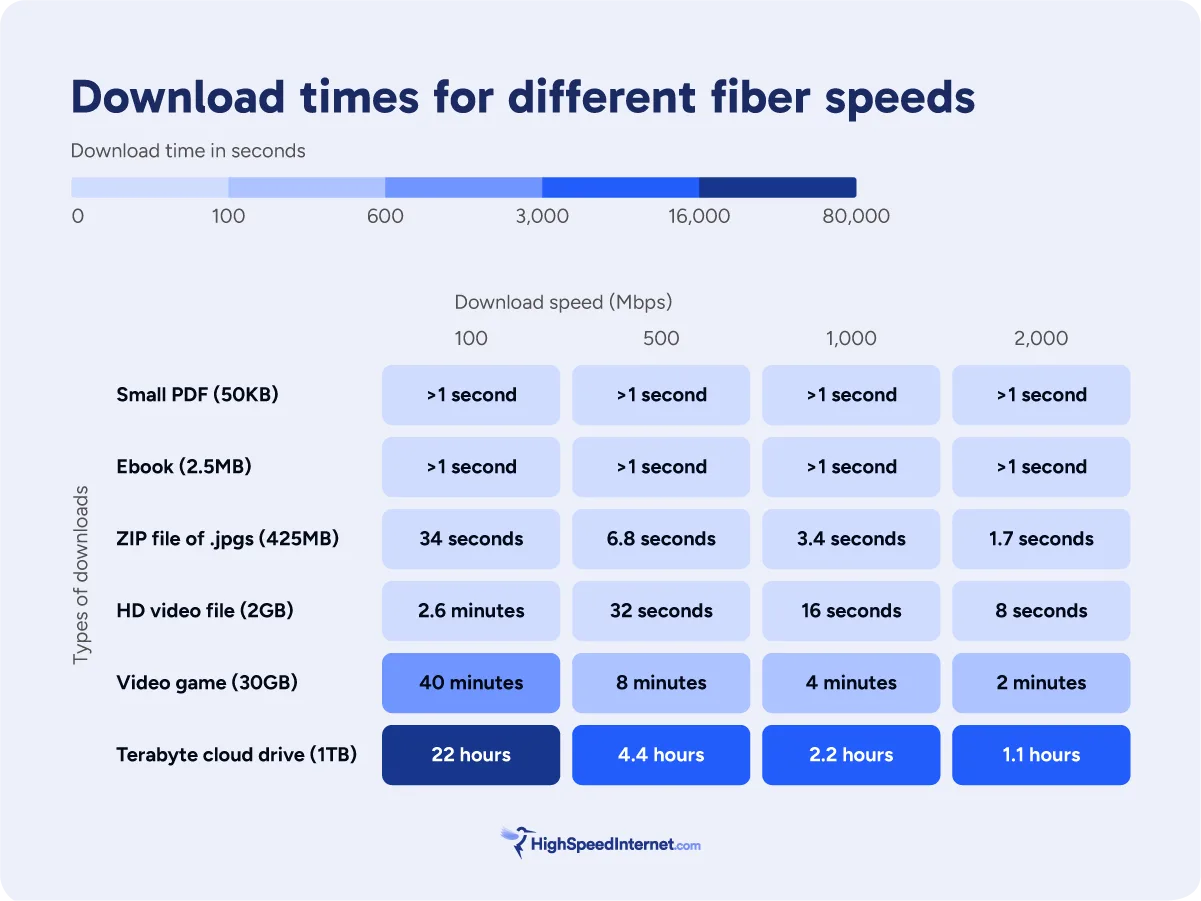
In practical terms, fiber is fast enough to keep up with extremely heavy internet use and various advanced online activities. It can also maintain a steady and reliable internet connection for multiple users who need to do speed-intensive tasks over the same Wi-Fi network at the same time.
Fiber is great for any of these tasks:
- Streaming 4K video on numerous devices
- Downloading massive files
- Uploading content to cloud servers and social media accounts
- Gaming online
- Teleconferencing on Zoom
- Connecting multiple smart home devices
Fiber internet upload speeds
While most internet providers emphasize the importance of download speeds, fiber internet also delivers record-fast upload speeds. This makes fiber a lot more useful for upload-centered activities like making video calls, posting to social media, and hosting livestreams.
So, how does this work, exactly? The difference between your download and upload speed has to do with what you’re using it for. When you download data, you get things from the internet. When you upload data, you put things onto the internet.
Examples of uploading data:
- Posting to TikTok
- Joining a Zoom meeting
- Uploading a file to the cloud
Internet users typically spend a lot more time downloading than they do uploading, so cable, DSL, and satellite providers don’t allocate more bandwidth for uploads. For example, a cable internet package that can get you 1,000Mbps download speeds may be capable of delivering only 35Mbps upload speeds.
What do internet users think of fiber internet?
It’s clear from the results of our Annual Internet Provider Review that fiber internet is the most popular connection type.
Two of the most highly rated internet providers in our survey—GFiber and Quantum Fiber—are fiber internet providers. They took the first and second spots for customer service and also ranked highly for other crucial categories like value and reliability.
Fiber services also rank highest in our Annual Customer Satisfaction Survey. With fiber’s symmetrical speeds and efficient fiber-optic infrastructure, fiber internet users didn’t have to deal with problems with congestion, recurring slowdowns, and buffering issues that are far more common with other internet types.
Fiber vs. DSL and cable
Fiber, DSL, and cable all transmit internet signals in a similar way: They carry binary signals (computer language) through cables over long distances. However, while DSL and cable use copper wires and electrical signals, fiber uses fiber-optic cables and blinking light signals.
The light signals used in fiber are faster and more efficient than electrical signals, and they have fewer issues with signal interference or degradation over long distances. That translates to faster, more reliable internet with very little lag.
In addition to being more efficient, fiber-optic threads are thinner than the copper wires used in cable and DSL infrastructure, so more of them can fit into a single cable. This increases the available bandwidth, which prevents network congestion and allows for gigabit speeds for you and everyone else on your street at the same time.
Where can I get fiber internet?
Fiber internet is easiest to get in cities and suburbs, but you may also have it in certain rural areas. Better yet, providers are building new infrastructure all the time, so you might have access now, even if you didn’t a few months ago.
Want to see if you can get fiber in your area? Type in your zip code below to see what’s available.

Can you get fiber at your address?
Enter your zip code for a list of local providers.
Learn more about fiber internet
FAQ about fiber internet
Do you need fiber gigabit speeds?
How much does 10Gbps internet cost?
Is 10Gbps internet fast?
What can I do with 10Gbps internet speeds?
What is gigabit internet?
Are fiber internet and gigabit internet the same thing?
How do I get fiber internet?
Do I need fiber internet for home security systems?
Plans disclaimers
AT&T Fiber plans
Internet 100 — N/A
Internet 300 | Internet 500 | Internet 2000 | Internet 5000 — Price includes $10/mo. discount when you sign up for paperless billing and AutoPay with a debit card or bank account. Or $5/mo. with a credit card.
Internet 1000 — New AT&T Fiber customers will receive $15 off the monthly recurring charge for 12 mos on an AT&T Fiber plan (300Mbps or higher). $10/mo if enrolled in Autopay & paperless billing w/ your bank account or the AT&T Points Plus® Card from Citi. Discount reduced to $5/mo when enrolled with a debit card. No discount if enrolled with any other credit card.
Brightspeed fiber plans
All fiber plans — Autopay required. Installation fee may apply. Limited availability in select areas. Prices may vary depending on location.
CenturyLink fiber plans
All fiber plans — Limited availability. Service and rate in select locations only. Paperless billing required. Taxes and fees apply.
EarthLink fiber plans
All fiber plans — with a 12 month contract. Actual speeds may vary depending on the distance, line-quality, phone service provider, and number of devices used concurrently. All speeds not available in all areas
Frontier plans
Fiber 200 — per mo. w/ Auto Pay for 12 mos.
Fiber 500 — w/ Auto Pay & Paperless Bill. Max wired speed 500/500 Mbps. Wi-Fi, actual & average speeds vary. One-time charges apply.
Fiber 1 Gig — w/ Auto Pay & Paperless Bill. Max wired speed 1000/1000 Mbps. Location dependent. Wi-Fi, actual & average speeds vary. One-time charges apply.
Fiber 2 Gig — w/ Auto Pay & Paperless Bill. Max wired speed 2000/2000 Mbps. Wi-Fi, actual & average speeds vary. One-time charges apply.
Fiber 5 Gig — w/ Auto Pay & Paperless Bill. Max wired speed 5000/5000. Wi-Fi, actual & average speeds vary. One-time charges apply.
Fiber 7 Gig — w/ Auto Pay & Paperless Bill. Max wired speed 7000/7000. Wi-Fi, actual & average speeds vary. One-time charges apply.
GFiber plans
Core 1 Gig | Home 3 Gig | Edge 8 Gig — N/A
1 Gig | 2 Gig — Plus taxes and fees. Upload/download speed and device streaming claims are based on maximum wired speeds. Actual Internet speeds are not guaranteed and may vary based on factors such as hardware and software limitations, latency, packet loss, etc.
5 Gig | 8 Gig — Available in select markets only. Plus taxes and fees. Upload/download speed and device streaming claims are based on maximum wired speeds. Actual Internet speeds are not guaranteed and may vary based on factors such as hardware and software limitations, latency, packet loss, etc.
Kinetic fiber plans
1 Gig | 2 Gig — With $5 Auto Pay for each month the customer is enrolled in AutoPay. Limited-time, non-transferable offer for residential customers that may not be combined with other promotions. Credit restrictions may apply. Subject to availability. Promotional period pricing ending after 24 months.
100 Mbps Tier 2 | 300 Mbps | 300 Mbps Tier 2 | 1 Gig Tier 2 — With $5 Auto Pay for each month the customer is enrolled in AutoPay throughout the life of the customer. Available to new and existing customers. Promotional period pricing ending after 12 months.
2 Gig Tier 2 — With $5 Auto Pay for each month the customer is enrolled in AutoPay throughout the life of the customer. Available to new and existing customers. Promotional period pricing ending after 24 months.
Max 2 Gig | Max 2 Gig Tier 2 — With $5 Auto Pay for each month the customer is enrolled in AutoPay. Limited-time, non-transferable offer for residential customers that may not be combined with other promotions. Credit restrictions may apply. Subject to availability. Promotional period pricing ending after 36 months.
Optimum plans
300 Mbps Internet — w/ $10/mo. elig. Auto Pay & Paperless Bill. Wired connection. WiFi speeds may vary. Not available in all areas.
500 Mbps Internet — w/ $10/mo. elig. Auto Pay & Paperless Bill. Wired connection. WiFi speeds may vary. Not available in all areas. HBO Max Basic With Ads plan auto renews after 6 mo. at the then prevailing rate (currently $10.99/mo.). Pricing sbjct to change. Terms apply.
1 Gig Internet — w/ $10/mo. elig. Auto Pay & Paperless Bill. Wired connection up to 940 Mbps. WiFi speeds may vary. Not available in all areas. HBO Max Basic With Ads plan auto renews after 12 mo. at the then prevailing rate (currently $10.99/mo.). Pricing sbjct to change. Terms apply.
2 Gig Internet | 8 Gig Fiber Internet — w/ $10/mo. elig. Auto Pay & Paperless Bill. Wired connection. WiFi speeds may vary. Not available in all areas. HBO Max Basic With Ads plan auto renews after 12 mo. at the then prevailing rate (currently $10.99/mo.). Pricing sbjct to change. Terms apply.
Quantum Fiber plans
1 Gig | 2 Gig | 3 Gig | 8 Gig — Limited availability. Service and speed in select locations only. Offer not available with Instant Internet service, Instant 360 WiFi service, or at bulk service properties. Limited time offer.
200 Mbps | 500 Mbps | 940 Mbps — Limited availability. Service rate in select locations only. Taxes and fees apply. New Quantum Fiber Customers Only.
Simply Fiber Internet Plan™ — N/A
Sparklight fiber plans
All fiber plans — with Auto Pay & Paperless Billing.
Verizon Fios plans
All fiber plans — Price per month with Auto Pay & without select 5G mobile plans. Consumer data usage is subject to the usage restrictions set forth in Verizon’s terms of service; visit: https://www.verizon.com/support/customer-agreement/ for more information about 5G Home and LTE Home Internet or https://www.verizon.com/about/terms-conditions/verizon-customer-agreement for Fios internet.
Ziply fiber plans
Fiber 100/100 | Fiber 300/300 | Fiber Internet Gig | Fiber Internet 2 Gig — For 12 months w/ paperless and autopay. No annual contract required. For new residential customers only. No annual contract required. Prices shown are before taxes and fees and require autopay and paperless billing. Service may not be available in all areas. Speeds shown for wired connections. Observable speeds will vary.
Fiber Internet 5 Gig | Fiber Internet 10 Gig | Fiber Internet 50 Gig — For 12 months w/ paperless and autopay. For new residential customers only. No annual contract required. Prices shown are before taxes and fees and require autopay and paperless billing. Service may not be available in all areas. Speeds shown for wired connections. Observable speeds will vary.
Deals Disclaimers
AT&T, Save up to $32/mo. — New customers only. $32 savings w/ 1Gig or higher plan. Ltd. avail/areas. AT&T Wireless: AT&T may temporarily slow data speeds if the network is busy. UP TO $32 OFF FIBER: Subj to change. New AT&T Fiber customers will receive a discount for 12 months off the monthly recurring charge for an AT&T Fiber plan ($15/mo w/300M or 500M; $32/mo w/1 Gig or higher). Pay full plan cost until discount starts w/in 3 bills. After 12 mos, prevailing rate for fiber plan applies. Residents of select multi-dwelling units not eligible.
Verizon Home Internet, Get a 3-Year Price Lock Guarantee — For new and existing myHome customers. Applies only to the then-current base monthly rate exclusive of any other setup and additional equipment charges, discounts or promotions, plan perk and any other third-party services.
Frontier a Verizon Company, Get Wi-Fi 7 with Included Premium Router — eero max speeds are derived from IEEE specifications. Coverage varies based on normal use and building conditions. Actual range and performance can vary. See https://eero.com/legal for more details.
Quantum Fiber, Save $240 Per Year on AT&T Wireless — $20 Wireless Discount: Subj to change. New or existing Quantum Fiber customers who have or purchase an eligible AT&T unlimited voice & data plan for smartphones will receive a $20/mo. discount on the AT&T wireless bill. Pay full plan cost for wireless plan until discount is applied within 1-3 bill cycles. Wireless and Internet accounts must match names and addresses to qualify. Must maintain Quantum Fiber and eligible AT&T wireless service for continued receipt of monthly discount on the wireless account. Tax on wireless service, if any, is calculated after the application of monthly discount. If you have other discounts, your monthly service charge on discounted wireless line will not be below $0. Req’d Wireless: Eligible plans, if new customer: Unlimited Premium PL, Unlimited Extra EL, Unlimited Starter SL, Value Plus VL, 4GB and 55+. AT&T may temporarily slow data speeds if the network is busy. Add’l fees, taxes and other charges & restr's apply. AT&T employees or residents of select multiple dwelling units not eligible.