Fastest Internet Provider 2026: T-Mobile Fiber
T-Mobile Fiber records the fastest speeds yet!

Apr 14, 2026 | Share 


Annual Review, Data and Research, Featured

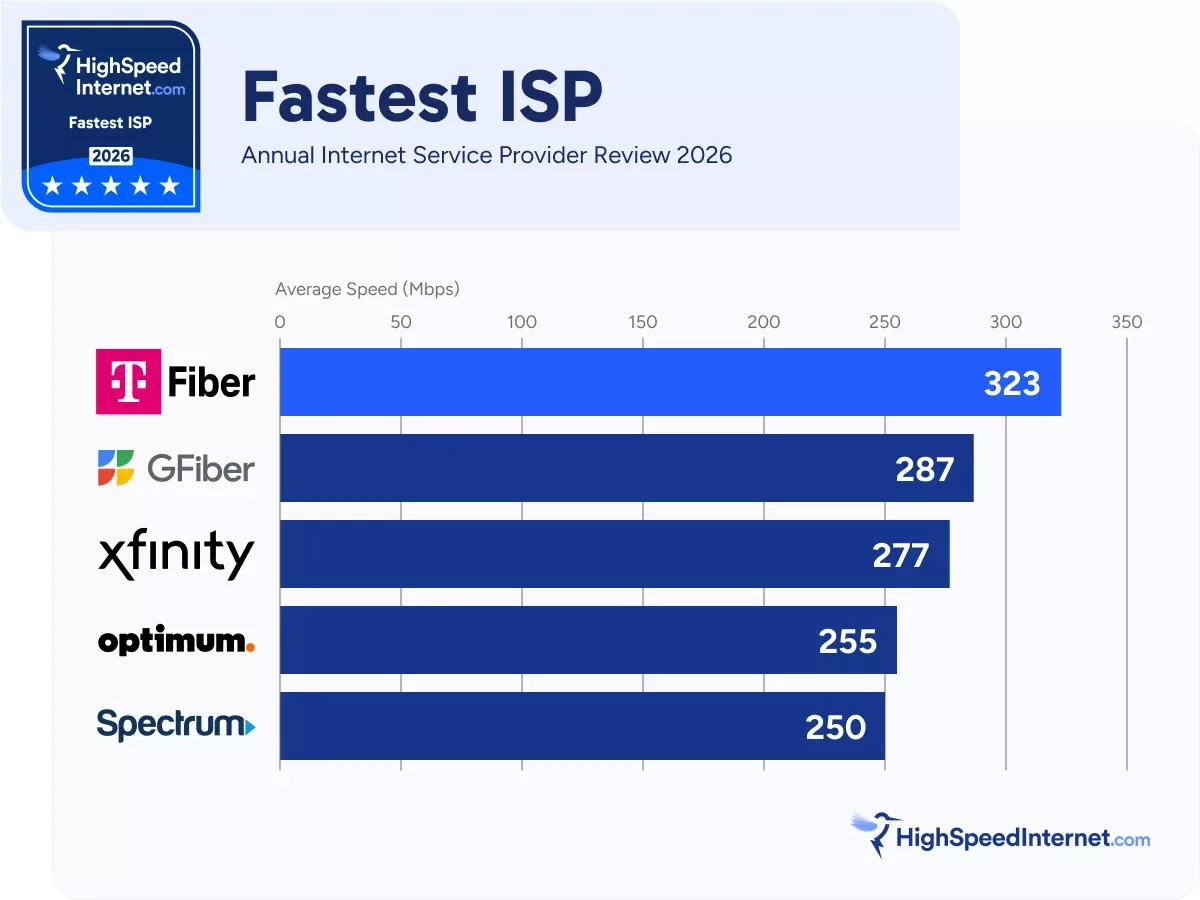
T-Mobile achieved the fastest speeds in the nation with an outstanding 323Mbps average speed on its fiber network. Though it’s the youngest major service in the country, T-Mobile’s fiber-to-the-premises (FTTP) service is already mirroring its 5G success. How? T-Mobile Fiber is following the same playbook of breaking norms in favor of the customers while delivering second-to-none service quality. It has all the elements that gave T-Mobile 5G Home Internet unprecedented growth and success, but this time, the service is backed by the increased potential only a fiber connection can offer.
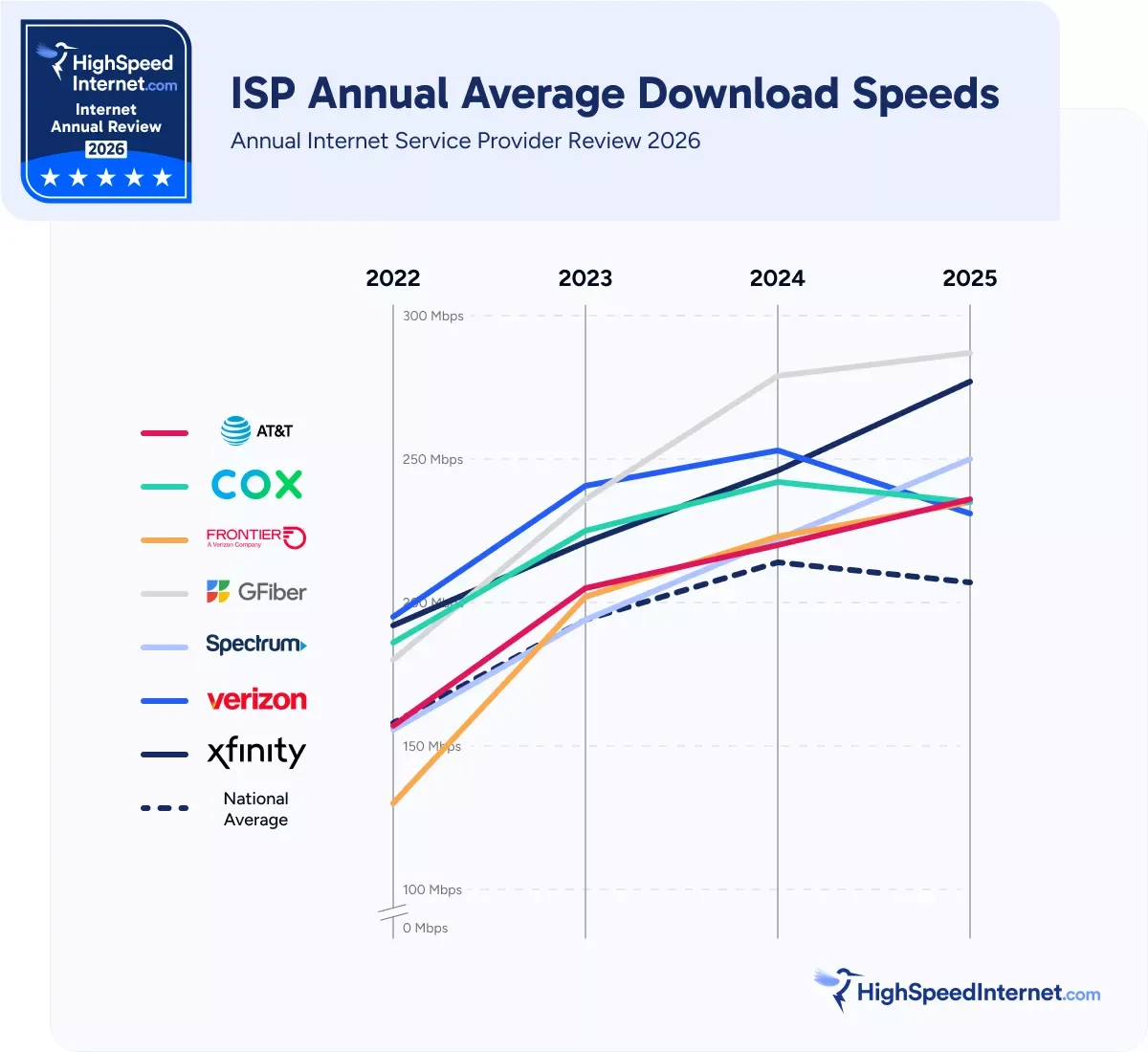
On the other hand, the outlook for the nation’s overall internet performance is beginning to dip into the red, as many internet service providers (ISPs) show heavily reduced or negative speed gains year-over-year. While the heavy hitters remain strong, other providers and the national speed average as a whole—aside from T-Mobile Fiber—have experienced an unexpected drop in performance.
How we measure speed
Every year, we analyze ISP performance using data from the HighSpeedInternet.com speed test, which collects about 5 to 8 million speed test results annually. We examine all performance indicators, like download speed, upload speed, latency, and jitter, but we only use download speed when ranking a provider’s national speed. Additionally, providers must meet eligibility requirements related to latency and jitter.
T-Mobile Fiber speeds
* Data calculated from the HighSpeedInternet.com speed test
T-Mobile’s performance advantage above all other providers in the nation is absolute. Usually, we see the top provider’s average speeds separated by about 5–10Mbps, as they all push similar technologies to the limit, and even a 2–5Mbps difference can have a big impact on performance. Last year, Brightspeed outpaced Google Fiber by 11Mbps, and the year before that, Cox pulled ahead by 10Mbps. However, this year is different. T-Mobile blew those past speed trophies out of the water.
T-Mobile Fiber leaped ahead of the runner-up, Google Fiber, by 36Mbps, about three times the average lead we typically see. Additionally, T-Mobile Fiber’s average speeds surpassed the third-place winner’s speeds by nearly 50Mbps. Because T-Mobile Fiber is a newer service, we confirmed our results with a larger public speed test data set. It maintained that T-Mobile Fiber was, indeed, America’s fastest ISP, indicating an even faster average speed than we calculated. A gap this large signals more than improved performance—it’s a different experience altogether.
The performance is in the plans
Technical advantages alone didn’t land T-Mobile the fastest speeds in the nation. To be the fastest ISP, you must be fast and accessible. People can’t benefit from a plan they can’t afford, and we can’t measure the speed of internet plans that nobody has, regardless of how capable a network may be.
Our analysis in 2024 suggests that if an ISP must choose between affordability and performance, affordability is the better choice. In the lead-up to 2024, Cox aggressively slashed prices in the form of free speed upgrades across the board. We’re talking about massive performance upgrades that even doubled some plan speeds, literally overnight, at no charge to the customers. That led to Cox achieving the fastest speeds in the nation in 2024, even outpacing Google Fiber.
T-Mobile’s success results from similar circumstances. T-Mobile entered the fiber market with extremely affordable rates, especially compared to other fiber providers. With fast and fully symmetrical fiber plans priced as low as $40 to $55 per month, T-Mobile is bringing the enviable performance of its fiber network within reach of the average household, even for those on a budget.
Compared to Google Fiber (one of our favorite ISPs), T-Mobile Fiber offers double the speed for the same price, with its 2Gbps fiber plan priced at only $70. Plus, T-Mobile offers five-year price locks, so customers know they’ll enjoy those rates for a while.
Many ISPs use fiber networks as a vehicle to charge customers more. We’re happy to see that T-Mobile instead chose to use fiber to offer its customers better deals.
Positioned for growth
T-Mobile shook the internet market with its debut service, T-Mobile 5G Home Internet. Back then, customers still had to be convinced of the viability of 5G for home internet service, a challenge that doesn’t exist with fiber. T-Mobile conquered 5G with outstanding pricing and policies that removed major pain points customers had been tolerating for years, like contracts, data caps, price hikes, and extra fees.
Officially launched in 2021, T-Mobile’s 5G service has grown ridiculously fast. T-Mobile celebrated over 8.5 million 5G Home Internet customers as of February 2026, and it plans to have up to 15 million 5G Home Internet customers by 2030.
T-Mobile Fiber is still bringing exceptional pricing and policies along for the ride, but this time, its efforts rest on the foundation of fiber internet, an exponentially more capable technology. T-Mobile Fiber launched in 2025 with 500,000 customers resulting from its acquisition of Lumos. There’s no doubt that this is a full-scale nationwide fiber play by T-Mobile as it continues to aggressively expand its fiber footprint with the recent acquisition of Metronet and its 3 million FTTP connections. T-Mobile plans to have up to 4 million fiber customers by 2030.
A revealing year for provider performance
Last year, we noticed providers weren’t improving at their usual pace, though they were still getting better on average. However, this year is worse. The average provider speed actually fell by about 7Mbps.
It’s important to emphasize that this doesn’t mean the best providers are any worse or stepping off the gas; that’s certainly not the case. World-class ISPs like Xfinity, Google Fiber, and the year’s fastest ISP, T-Mobile Fiber, are faster than ever and continue to improve at the expected rate, if not beyond it.
* Data calculated from the HighSpeedInternet.com speed test
Unfortunately, some ISPs either significantly slowed their rate of improvement or are just flat out getting slower on average, and that trend is consistent enough to pull average speeds as a whole into the red zone. We saw the average internet speed skyrocket in the years following the pandemic as quality internet service was more valuable than ever. We may not be literally stuck inside our homes anymore, but fast internet service continues to be a necessity.
The problem may not be solvable by increased capabilities or faster networks. We’ve always maintained that gigabit service (1,000Mbps) and above is vastly more bandwidth than the average household could ever meaningfully utilize. For the average person, those blazing speeds only benefit you when you’re transferring huge files, and today, most content is streamed anyway.
The country’s internet customers don’t need more multi-gig plans; they need more affordable plans in the 200–500Mbps range, at prices they can afford. And that’s exactly what T-Mobile is offering as it enters the fiber market in the U.S. T-Mobile has its finger on the pulse of America’s internet landscape and continues to demonstrate it time and time again through its business decisions, especially with pricing and policy. If this continues, we see good things in T-Mobile’s future.
Author - Austin Aguirre
Austin worked as a broadband technician installing and troubleshooting countless home internet networks for some of the largest ISPs in the U.S. He became a freelance writer in 2020 specializing in software guides. After graduating with a BS in technical communication from Arizona State University, he joined the team at HighSpeedInternet.com where he focuses on home network improvement and troubleshooting.
Editor - Jessica Brooksby
Jessica loves bringing her passion for the written word and her love of tech into one space at HighSpeedInternet.com. She works with the team’s writers to revise strong, user-focused content so every reader can find the tech that works for them. Jessica has a bachelor’s degree in English from Utah Valley University and seven years of creative and editorial experience. Outside of work, she spends her time gaming, reading, painting, and buying an excessive amount of Legend of Zelda merchandise.
Related Posts