Home Internet Contracts Are Dead
Once common, early termination fees have all but disappeared

Aug 7, 2026 | Share 


Internet Buying Guides
It’s the end of an era in home internet, and you heard it here first: The annual contract on home internet is officially dead.
New competition from fiber and 5G home internet providers did the deed, customer guarantees signed the death certificate, and multi-year price locks hammered the coffin lid shut.
How we know internet contracts are gone
We keep a list of every major home internet provider in the country, and our massive database tracks each plan they offer. For many years, we’ve included details like price, max upload and download speed, technology type, required equipment fees, and more. We also track contract length and early termination fees (ETFs)—once an essential factor in choosing between internet providers.
Over the last few years, we’ve seen more and more plans with no listed cancellation fee and, therefore, no required contract. During a recent round of updates to some of our key recommendations, I had a hunch that contracts had become much less relevant than they once were.
I followed the digital trail all the way to checkout carts from home internet providers nationwide, and checked my gut feeling against broadband labels for several real addresses. Sure enough, contracts had disappeared for every fiber and cable company I researched.
I found only minor exceptions: satellite and traditional fixed wireless internet providers, and the occasional broadband reseller. We’ll get into that in a second.
How did home internet contracts die, and whodunnit?
As recently as two years ago, we wrote about contracts and early termination fees every time we reviewed internet providers. We told people to expect a fee of $10 to $15 for every month remaining on their 12- or 24-month contract if they left early.
It didn’t take long to notice that most fiber internet plans skipped the contract. Then, we noticed that no 5G home internet providers required them. As we finalized our Annual Internet Service Provider Review in 2026, it became clear that we needed to re-evaluate our pricing recommendations for home internet across the board.
The rise of fiber and 5G home internet plans
It might be a little too early to convene a grand jury, but the circumstantial evidence is clear: 5G killed internet contracts, and fiber internet formulated the master plan. The method was simple: competition. Just offer great home internet service, but with better terms.
The first fiber-to-the-premises (FTTP) internet connections were installed way back in the 1980s, but the tech didn’t gain a foothold until Verizon Fios debuted in 2004. Since then, fiber has exploded in popularity. Fiber internet is now available to more than 60% of homes, with prices that rival cable internet, and upload speeds that leave cable in the dust.

The first 5G home internet connections were offered back in 2018, with national rollouts starting in 2021. By the end of 2024, the internet type had exploded in popularity. Now, between 15 and 16 million homes are connected via 5G, making up about 12% of the total home internet market.

Fiber’s popularity makes sense. It’s widely considered the fastest and most reliable connection type, and it’s what we recommend most often. Better yet, contracts have rarely been required.
The growth of 5G home internet tracks too. It’s fast enough for a lot of households, and it’s a good deal. Features like free trials, gifts for signing up, and steep discounts when you combine your 5G home internet with mobile service make it worth a try for anyone who’s unhappy with their current provider. Instead of contracts, these companies offer free trials and make setup super simple.

Pro tip: Get perks and deals when you switch
You can get gift cards, free stuff, and streaming subscriptions just for switching providers, but you have to know what to look for. Check out my monthly deals roundup and scan for your local providers to see what’s on offer.
FCC Broadband labels and the fight against junk fees
Just as competition started heating up the marketplace, regulators started to look closely at what they called “junk fees,” but it went beyond home internet contracts. The discussions also included fees added to hotel stays, concert tickets, banking services, and TV bills.
Officials tried to change laws and regulations in a variety of ways, but they were more of a witness to the crime than an active participant.
In February of 2019, the Truth-in-Billing, Remedies, and User Empowerment over Fees Act was introduced in the U.S. House of Representatives. It would have mandated transparent pricing and prohibited all “below the line” fees, including early termination fees. It never got a hearing.
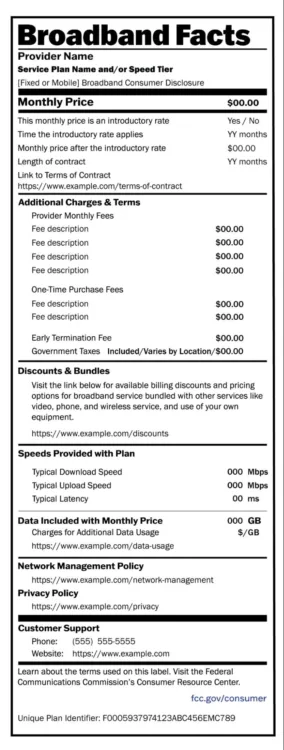
Internet providers are required to show labels like this one to prospective customers before they buy internet service. Since these labels have been mandated, almost all internet providers have stopped requiring contracts and assessing early termination fees. Source: FCC.gov.
Within months, Consumer Reports added fuel to the fire with its 2019 report, “How Cable Companies Use Hidden Fees to Raise Prices and Disguise the True Cost of Service.”
Things were relatively quiet on the contracts front while the world grappled with COVID-19, but the issue bubbled back to the surface when Congress passed the Infrastructure Investment and Jobs Act in November of 2021. The law directed the Federal Communications Commission (FCC) to create clear labels for internet plans. The rules required providers to display broadband nutrition labels at the point of sale.
The rules were finalized in 2022 and went into effect for large providers in April 2024, but they were required for all providers by October of that year. These didn’t add any mandates about the contracts, but they forced providers to be transparent up front.
By 2023, the Federal Communications Commission (FCC) tried to address consumer complaints about fees by announcing a plan to prohibit early termination fees and ban other junk fees. That plan was never finalized. A 2025 ruling from the Federal Trade Commission (FTC) bans junk fees related to short-term lodging and concert tickets, but didn’t address cable or internet bills.
Fast forward to 2026, and no federal rules prevent home internet providers from setting contract terms or assessing early termination fees, but both have evaporated among the biggest providers.
Customer guarantees and multi-year price locks
Contracts may have been breathing their last gasp in 2023, but their demise was written in ink when cable companies started offering multi-year price locks.
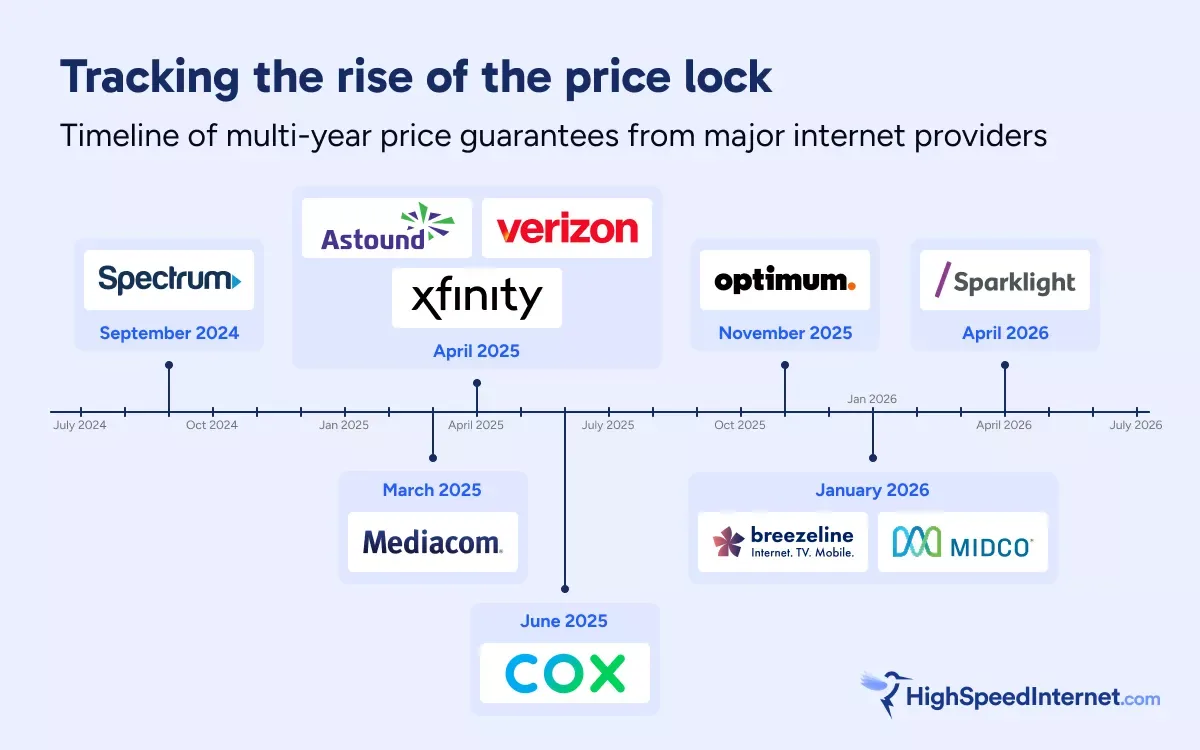
Internet providers started offering plans with multi-year price locks in 2024 and 2025. By the first quarter of 2026, all major internet providers had stopped requiring annual contracts.
Spectrum made a splash in September of 2024 with an “unprecedented customer commitment” that “guaranteed pricing for up to three years with no annual contracts.” Reading the fine print, it became clear that only certain bundle customers were eligible for the three-year price locks. However, early termination fees were out for everyone.
With merger between Spectrum and Cox being official, the companies have promised not to impose contracts on Cox customers either.
In April of 2025, Xfinity announced new five-year price locks on certain plans, with no annual commitment required. Slightly less expensive plans are available with price locks of only a year, but they don’t require a contract either. Verizon also announced three-year price locks that month, also without any hint of early termination fees for home internet customers.
Each of the following also offers price locks of at least two years. None makes you sign up for a contract to lock in that low price.
We’ve been around long enough to take anything we hear from big corporations like this with a grain of salt, but we’re encouraged. The big internet companies really do seem to be treating their customers better.
An industry analyst’s perspective
I reached out to a handful of industry analysts to make sure I was on the right track with declaring the demise of annual contracts, and turns out our plan database is the best in the business. However, Roger Entner, founder of Recon Analytics, called me back right away to opine on the end of contracts.
He confirmed that early termination fees are definitely on the way out and said it was due to competition in the marketplace. Broadband labels increased visibility, he said, but weren’t to blame.
How providers can still lock you in
Early termination fees may be a thing of the past, but there are still a few ways you could see charges if you decide to switch providers.
Reward cards and perks
Many companies offer perks and giveaways to new customers, and it’s a great reason to consider shopping a few times a year. These deals change month to month but often include prepaid gift cards, free smart glasses, or free smart TVs.
If you accept one of these offers and leave too soon, you may be on the hook for repaying the company. If you take Verizon up on its offer for free Ray-Ban Meta glasses or up to $500 in Samsung products, for instance, Verizon reserves the right to charge back the value of the glasses if you leave within six months.
AT&T Fiber has a similar six-month rule for customers who agree to receive gift cards when they sign up for internet service.
Mobile bundles
Many internet providers also offer mobile phone service, and bundling can be a nice way to save money. Like with home internet plans, most mobile plans these days are available without term contracts or early cancellation fees. You have to watch out for term agreements that kick in when you accept deals on smartphones or other devices, though.
Typically, you’ll get a free phone or a big discount on a phone when you sign up for a new carrier. The cost doesn’t just disappear into thin air, though. Instead, you’ll have to pay taxes for the phone up front, and then you’ll see a monthly charge for financing the phone, with a corresponding credit. If you stay with the carrier long enough, you’ll keep getting those charges and credits until your phone is paid off. If you leave early, though, you’ll have to give your phone back or pay any outstanding balance.
Phone financing from the big bundle providers can last from two to three years, depending on whether you get a mid-grade or premium phone. Most of the time, you can’t get your phone unlocked until your payment plan is complete.
It’s not exactly an early cancellation fee because you do get to keep the phone. But it is a way to lock you into a premium mobile plan or bundle.
Why you may see ETFs with satellite or fixed wireless internet
We scoured our entire database of home internet plans for early cancellation fees and found only a few instances. Honestly, they both make sense.
First, you could see an early cancellation fee with traditional satellite internet. With Viasat, that fee is $15 per month remaining on a 12-month contract. In exchange for signing the contract, you get professional help with installing your satellite dish on the outside of your home.
Low-Earth orbit satellite internet Starlink doesn’t charge early termination fees, but you’re responsible for the installation yourself. National brands like Best Buy charge $279 for a standard mounting.
The other type of home internet that sometimes comes with early termination fees is traditional fixed wireless internet, which also requires a receiver dish to be affixed to the outside of your home. If you decline the contract, your bill may go up by $5 per month, or you’ll be charged $150 for the install.
If you see contracts elsewhere, you might not be shopping with a reseller such as Earthlink rather than a primary provider. In most cases, go with the provider that owns the network instead.
My take: Celebrate contract freedom
Internet contracts are dead, and for the best reasons: transparency and competition. Entner put it succinctly, and I agree:
“Cable has gotten the message, and they have pledged to do better. We’re seeing this all over the place, which is a wonderful thing,” he said. “Cable companies just kind of have to live with it because there are better choices.”
Cable companies may bemoan the death of cancellation fees, but customers should celebrate! It’s a great time to make sure you’re getting the best possible price on home internet.
This handy tool lets you search that sweet database we mentioned above using your own zip code:

Could you save on home internet costs?
Enter your zip to shop and compare local providers.
Author - Chili Palmer
Chili Palmer covers home tech services, with a special focus on understanding what families need and how they can stay connected on a budget. She handles internet access and affordability, breaking news, mobile services, and consumer trends. Chili’s work as a writer, reporter, and editor has appeared in publications including Telecompetitor, Utah Business, Idaho Business Review, Benton Institute for Broadband & Society, and Switchful.com.
Editor - Jessica Brooksby
Jessica loves bringing her passion for the written word and her love of tech into one space at HighSpeedInternet.com. She works with the team’s writers to revise strong, user-focused content so every reader can find the tech that works for them. Jessica has a bachelor’s degree in English from Utah Valley University and seven years of creative and editorial experience. Outside of work, she spends her time gaming, reading, painting, and buying an excessive amount of Legend of Zelda merchandise.
Related Posts