How Many Satellites Are Around the Earth?
The total number of satellites in orbit continues to grow

Sep 1, 2026 | Share 


Technology
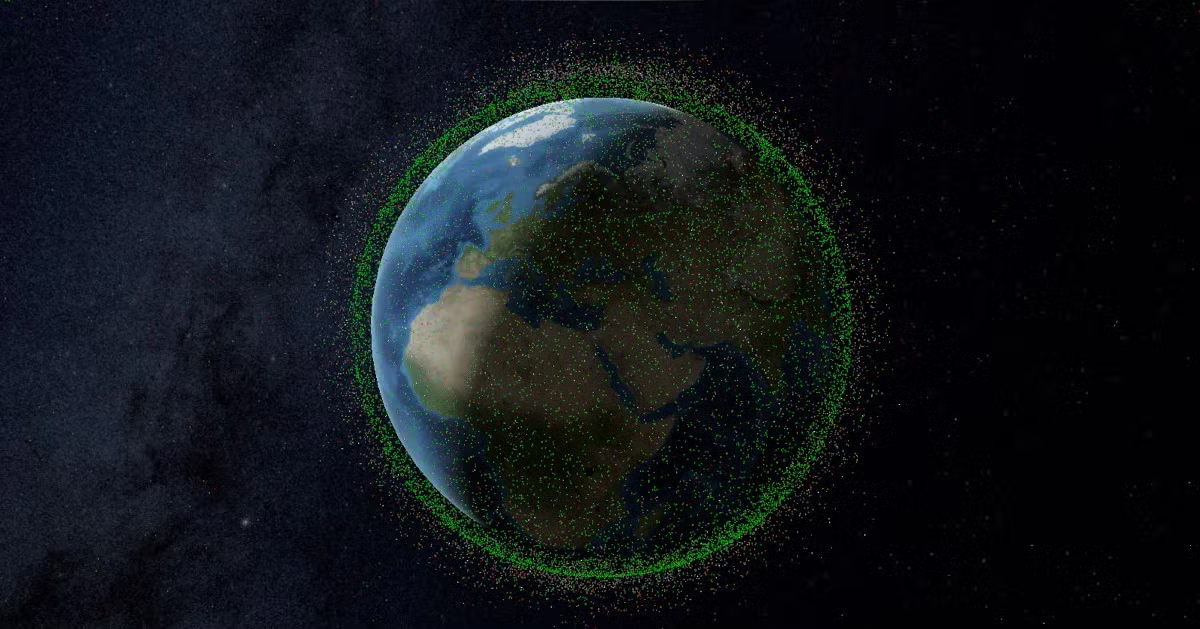
Satellites in orbit around the Earth. Image courtesy of Spacebook.
There are currently approximately 16,400 to 18,600 active satellites in orbit around the Earth, according to satellite tracking services like Orbital Radar and COMSPOC. With Starlink, OneWeb, Amazon Leo, and other low-Earth orbit (LEO) constellations launching hundreds of new spacecraft every year, that number has jumped up considerably in recent years.
Of course, that’s only the active satellites. If we include decommissioned satellites, rocket bodies, and debris fragments, there are thousands more objects streaking across the skies at any time. These objects have a profound impact on the future of satellite internet and spaceflight more broadly. Let’s take a closer look.
Who has the most satellites in orbit?
We’ve had artificial satellites in orbit around the Earth since the launch of Sputnik 1 by the Soviet Union in 1957. Although several other countries have thrown their hats into the ring since the Space Race, satellite ownership is still concentrated among a small group, with the United States, Russia, China, and the United Kingdom operating the vast majority.
| Country | Number of satellites* |
|---|---|
| United States | 8,000–12,803 |
| Russia | 1,137–1,500 |
| China | 800–1,275 |
| United Kingdom | 700–719 |
| Japan | 129–203 |
| European Union | 83–320 |
| India | 52–108 |
| Canada | 47–105 |
| South Korea | 43–62 |
| United Arab Emirates | 15–35 |
* Based on data from Orbital Radar, Kongsberg NanoAvionics, KeepTrack, and LeoLabs. Data as of 8/27/2026.
By far the biggest operator of satellites is U.S.-based Starlink, which, as of Aug. 21, 2026, has approximately 11,045 satellites in orbit, with other LEO constellations like Amazon Leo and China’s Guowang and Qianfan constellations slowly catching up.
Here at HighSpeedInternet.com, we’re mostly concerned with satellites that provide internet service, but there are many other types in orbit. These include satellites for navigation, Earth observation, space science, military applications, and communications.
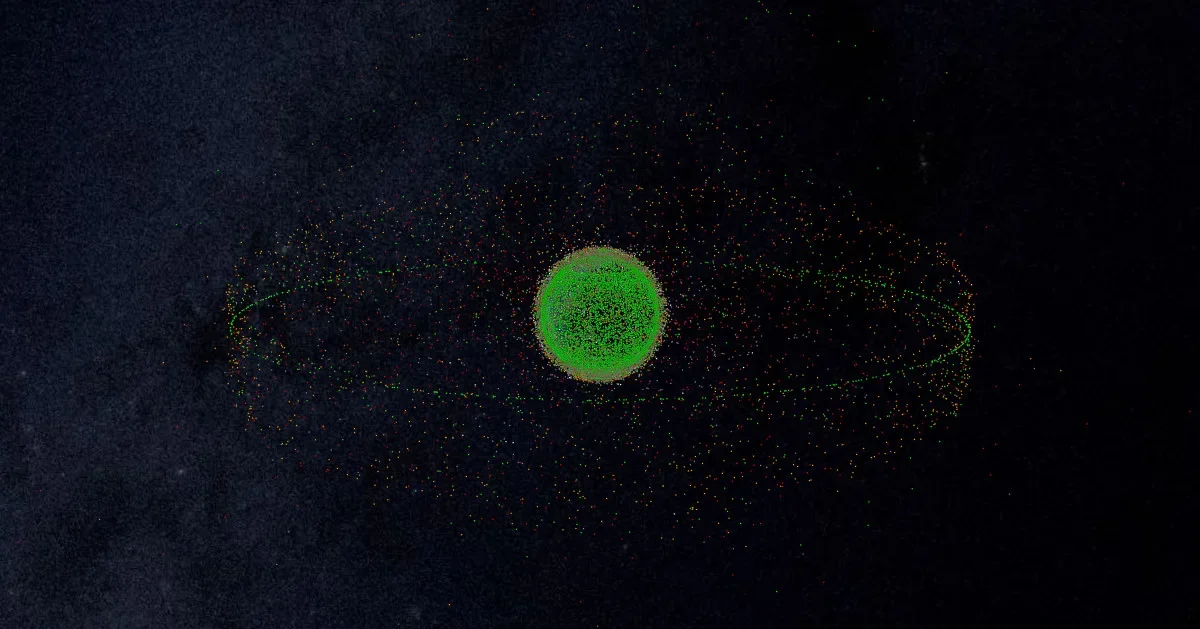
LEO, MEO, and GSO satellites in different orbits around the Earth. Image courtesy of Spacebook.
Satellites can also be divided up by their placement in orbit. While the vast majority of satellites are in low-Earth orbit, thanks to the growth of LEO constellations like Starlink, there are also satellites in medium-Earth orbit (MEO) and geosynchronous orbit (GSO). Due to the amount of fuel and other resources required to move a satellite into these more distant orbits, there are far fewer MEO and GSO satellites, but they tend to be much larger.
The most valuable piece of real estate in geosynchronous altitudes is the orbit directly above Earth’s equator. When in this position, known as geostationary orbit (GEO), a satellite’s movement is precisely matched up with the rotation of the Earth below it, so it never appears to move in the sky. As such, there is a dense ring of satellites circling the Earth at this position.

Are you looking for reliable satellite internet?
Enter your zip code to see what options are available in your area.
What is a satellite?
When we say satellite, we’re usually referring to artificial satellites, though there are natural satellites like moons and other astronomical objects. More specifically, we’re usually talking about active, functional, unmanned spacecraft in orbit around the Earth. If, however, we’re speaking about artificial satellites more broadly, there are quite a few other types of objects we’ve put into orbit, for better or for worse.
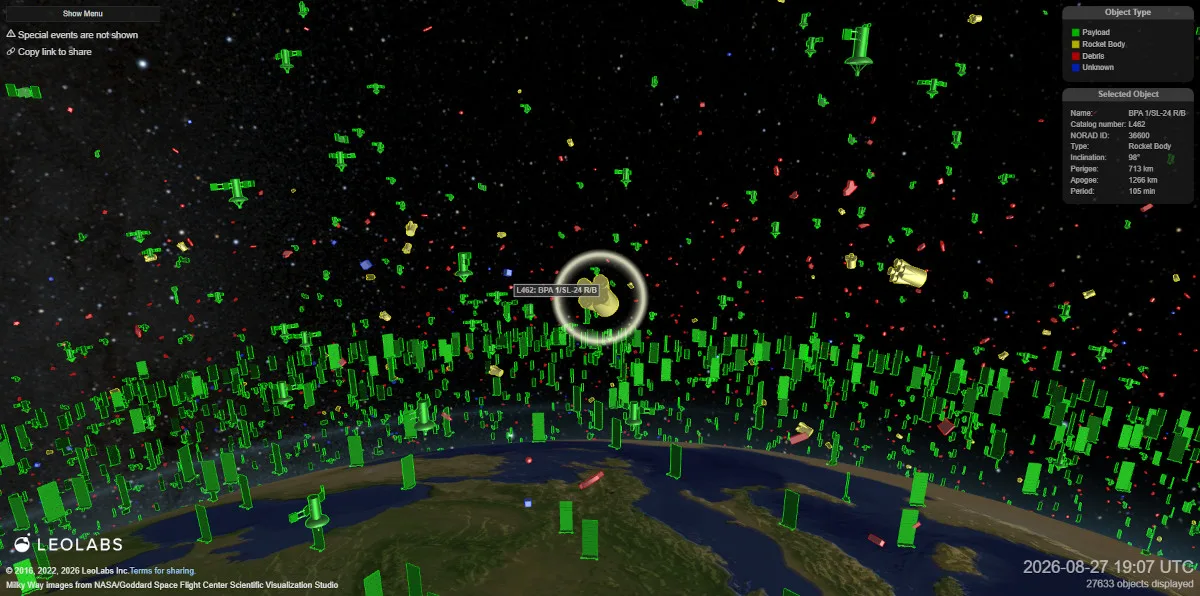
Satellites and rocket bodies in orbit. Low Earth Orbit Visualization © 2026 LeoLabs.
Some of the biggest artificial satellites in orbit are rocket bodies left behind from previous missions. In the early days of the Space Race, not much thought was given to the upper stages of a rocket that were discarded as the next stage ignited. After nearly 80 years’ worth of rocket launches, this has become a more salient issue.
There are also many satellites in orbit that have long ceased to function and simply remain on their current trajectory. Once again, the ultimate fate of dead satellites was not the most pressing concern in the early days of space exploration, so many of the dead satellites in orbit are very old. Nowadays, satellites reaching the end of their mission keep enough fuel on board to either de-orbit and burn up in the atmosphere, or to at least push themselves out of the way so that they don’t crash into other satellites.
And that leads us into the most numerous objects in Earth’s orbit: space debris.
The problem of space debris
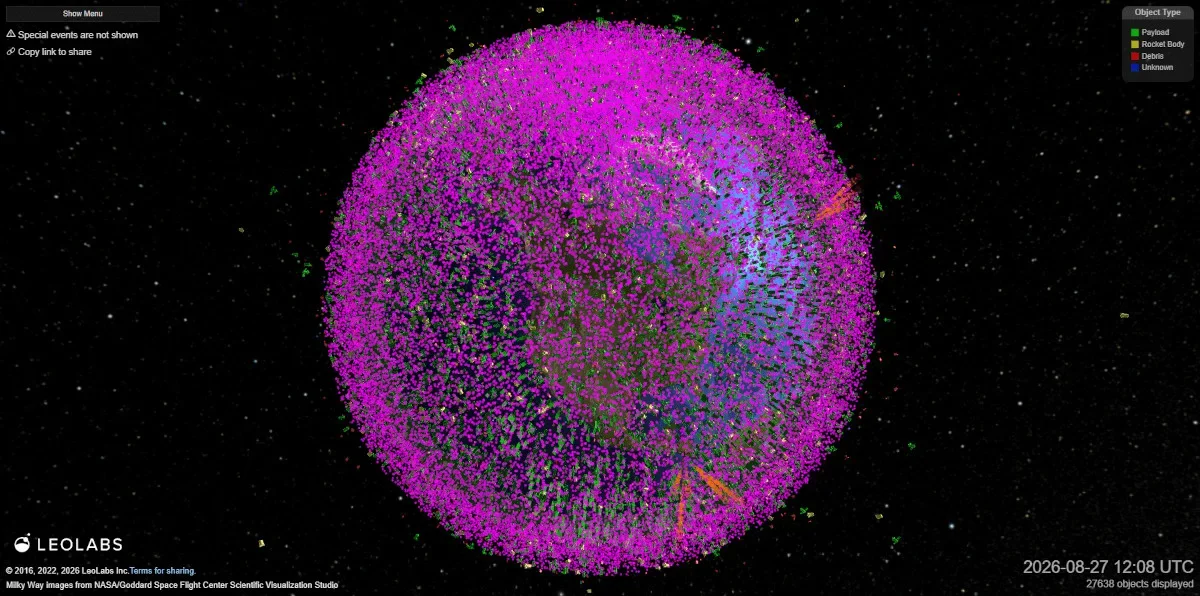
Orbital Debris. Low Earth Orbit Visualization © 2026 LeoLabs.
The European Space Agency reported in 2025 that there were about 40,000 objects in orbit actively tracked by space surveillance networks (including active satellites). That same report estimated that the actual number of space debris objects larger than 1 centimeter in size (which is large enough to cause catastrophic damage on impact) is over 1.2 million. And the numbers are increasing faster every year.
Space debris comes from two main sources. The first is mission-related debris, such as spent rockets and dead satellites. This also includes smaller items like bolts, lenses, and O-rings that come loose from spacecraft or are ejected during stage separation.
The second major source is from fragmentation events, such as explosions and collisions. Many of the spent rocket bodies in orbit retained some residual fuel in their tanks or fuel lines. Over time, the harsh environment of space degrades mechanical parts, which has led to these spent rockets exploding and scattering tiny pieces of debris into orbit.
Two of the biggest fragmentation events were not accidents, but anti-satellite weapons tests. The first was the Chinese Fengyun-1C test in 2007, which destroyed a weather satellite and scattered debris across a wide range of altitudes. To this day, it remains the biggest single contributor of cataloged space debris. The second was the Russian Kosmos 1408 test in 2021, which created a cloud of debris that threatened the International Space Station.
Debris mitigation and long-term sustainability are now a high priority for any Satellite mission. This was one of the main selling points when Starlink first launched, purposefully designing its satellites to de-orbit in just a few years. Scientists are now looking at ways to actively remove debris in orbit in order to ensure the long-term sustainability of commercial satellites and space exploration.
Author - Peter Christiansen
Peter Christiansen writes about telecom policy, communications infrastructure, satellite internet, and rural connectivity for HighSpeedInternet.com. Peter holds a PhD in communication from the University of Utah and has been working in tech for over 15 years as a computer programmer, game developer, filmmaker, and writer. His writing has been praised by outlets like Wired, Digital Humanities Now, and the New Statesman.
Editor - Jessica Brooksby
Jessica loves bringing her passion for the written word and her love of tech into one space at HighSpeedInternet.com. She works with the team’s writers to revise strong, user-focused content so every reader can find the tech that works for them. Jessica has a bachelor’s degree in English from Utah Valley University and seven years of creative and editorial experience. Outside of work, she spends her time gaming, reading, painting, and buying an excessive amount of Legend of Zelda merchandise.
Related Posts