Private Internet Access vs. ExpressVPN: Which VPN Is Better?
Nov 17, 2026 | Share 


Security, VPN Vs.


* Availability may vary by location, and prices are subject to change. See Private Internet Access disclaimers | ExpressVPN disclaimers.
Compare Private Internet Access and ExpressVPN head-to-head
Which VPN is better, Private Internet Access or ExpressVPN? The easy answer for most is Private Internet Access (PIA) because it costs less, covers unlimited devices on a single plan, and runs a far bigger server network. ExpressVPN also makes a strong case, with faster speeds, the easiest refund we’ve seen, and a long list of premium extras.
But you can read that anywhere. We actually tested both of these providers, and here’s how it nets out.
Overall, our research gives PIA the nod in scoring, coming in at 85/100 to ExpressVPN’s 79/100. For more, check out our Private Internet Access and ExpressVPN reviews. For the true head-to-head comparison, here’s how these two top-notch VPNs compare.
Private Internet Access vs. ExpressVPN at a glance
| Private Internet Access | ExpressVPN | |
|---|---|---|
| Overall score | 85/100 | 79/100 |
| Starting price | $1.33/mo. (3-yr. plan) | $2.49/mo. (Basic) |
| Month-to-month price | $11.95/mo. | $14.99/mo. |
| Free plan | No | No |
| Servers | 29,000+ in 91 countries | 3,000+ in 113 countries |
| Simultaneous devices | Unlimited | 10–14, depending on plan |
| Money-back guarantee | 30 days (direct purchases only) | 30 days (direct purchases only) |
| Company background | Launched 2010; Denver, Colorado headquarters; owned by Kape Technologies since 2019 | Launched 2009; British Virgin Islands headquarters; owned by Kape Technologies since 2021 |
Availability and speed may vary by location, and prices are subject to change. See disclaimers.
In this comparison:
Pricing | Speed and performance | Features | Security and privacy | Apps | Billing and cancellation | Final verdict | FAQ
In this comparison:
 Pricing: PIA gives you more for less
This one is obvious: PIA wins on price. It’s cheaper month to month, cheaper on its long-term plans, and far simpler to buy. There’s only one plan, and it includes every feature PIA offers on unlimited devices. Even better, PIA renews at the same rate you signed up for.
ExpressVPN splits its features across three tiers, and you’ll need the top one to get everything. Renewal is where it really stings. Our ExpressVPN invoice showed our plan renewing at almost double the intro price, and that rate never showed up in our account. You’d think a premium VPN would be upfront about what you’ll pay next, right? Not here.
Here are the renewal rates you can expect if you commit to either of them.
| Plan | Price range | Renewal rate | What's included |
|---|---|---|---|
| PIA VPN | $1.33–$11.95/mo. | $11.95/mo. | |
| ExpressVPN Basic | $2.49-$14.99/mo. | $99.95/yr. | |
| ExpressVPN Advanced | $2.99-$16.99/mo. | $119.95/yr. | |
| Express Pro | $5.49-$22.99/mo. | $199.95/yr. |
* Availability and speed may vary by location, and prices are subject to change. See disclaimers.
 Speed and performance: ExpressVPN pulls ahead
ExpressVPN earned the higher speed score, and it showed in daily use. We took Zoom calls all day on ExpressVPN without any lag or freezing, and it held onto more bandwidth than PIA in both directions. PIA fought back on responsiveness, keeping latency and jitter lower on nearby servers, with one of the best jitter results we’ve recorded. Here’s the speed breakdown so you can see how they compare.
| Local server result | PIA | ExpressVPN | Winner |
|---|---|---|---|
| Download speed | 732Mbps (-22.2%) | 847Mbps (-9.9%) | ExpressVPN |
| Upload speed | 749Mbps (-21.0%) | 864Mbps (-8.9%) | ExpressVPN |
| Latency | 50.28 ms (+96%) | 65.79 ms (+156%) | PIA |
| Jitter | 7.61 ms (+126%) | 14.96 ms (+345%) | PIA |
A quick note on distant servers: On a far-off server, ExpressVPN held up better across the board, with faster downloads and uploads and less lag than PIA.
What does that mean for you? If you download big files or connect to servers overseas, ExpressVPN is the better pick. If you game on nearby servers, PIA’s steadier connection gives it a slight edge.
 Features: ExpressVPN piles on perks, PIA perfects the VPN
PIA and ExpressVPN have a lot of overlap. Both offer a kill switch, split tunneling, ad and malicious site blocking, multiple protocols, a dedicated IP option, and help getting around age verification and regional blocks. You’re covered on the essentials either way.
Where they split is the philosophy. ExpressVPN builds outward with premium extras like post-quantum protection, a private email relay, a built-in speed test, a password manager, ID alerts, a travel eSIM, identity theft insurance, and ExpressAI, a private AI chat tool. The catch is that the best perks are saved for its pricier tiers. PIA stays focused on the VPN itself and gives you more control over it, with multi-hop, obfuscation, an advanced kill switch that blocks all traffic until the VPN is on, and a choice of encryption strengths, all on its one plan.
The unique offerings won’t change how either VPN protects you day to day. If you want an all-in-one privacy bundle, go Express. If you want a powerful, no-nonsense VPN that covers every device in the house, go PIA.
 Security and privacy: It’s a tie
Let’s be clear: Both PIA and ExpressVPN are safe choices, and both earned a perfect security score from us. Each uses AES-256 encryption, runs RAM-only servers that can’t store your data long-term, and has a no-logs policy verified by third-party audits. They’re even owned by the same company, Kape Technologies.
What sets PIA apart is transparency. Deloitte has confirmed its no-logs policy three times, and PIA lets anyone read the audit report, not just paying customers. Its code is 100% open source, too, so anyone can check it for weaknesses.
ExpressVPN brings its own strengths. It adds ChaCha20 encryption, benefits from the British Virgin Islands’ strong privacy laws, and has never had a privacy or security breach. The one asterisk applies to both: Kape’s past issues with ad and malware distribution raised some eyebrows when it bought these brands.
 Apps: It’s a tie
Both apps earned a perfect score from us, and both show a live ping for every server, something most VPN apps skip. PIA keeps things lean, using every inch of the screen for what you need with no upsells in sight. ExpressVPN packs in more, with plain-English protocol explanations, a built-in speed test, and rules that connect the VPN automatically when you join a new network.
 Billing and cancellation: ExpressVPN makes it painless
Both providers offer a 30-day money-back guarantee, and both honored it. The difference was how much work it took. ExpressVPN lets us request a refund right from our online account in a few clicks, without ever talking to support. With PIA, we had to file a support ticket and wait about a day for a reply. Once PIA got back to us, the refund came quickly, and it didn’t even ask for a reason. For sheer ease, though, ExpressVPN wins this hands down. Check out the step-by-step breakdown for cancellation below.
| PIA | ExpressVPN | |
|---|---|---|
| How to request a refund | Support ticket or email | Self-serve in your online account |
| Our reviewer's experience | Reply in about 24 hours, no reason required | Done in a few clicks, no issues |
| Refund timing | About 8 hours after confirming | Immediately |
 Pro tip: Buy either VPN directly from its website. Purchases made through app stores don’t qualify for either provider’s 30-day money-back guarantee.
 Final verdict for Private Internet Access vs. ExpressVPN: PIA wins!
Yes, PIA wins overall, 85/100 to 79/100. ExpressVPN won on speed and billing, and the two tied on security and apps, but PIA’s leads on price, servers, and devices were big ones. Those are the things you’ll feel in your wallet and across every device in your home.
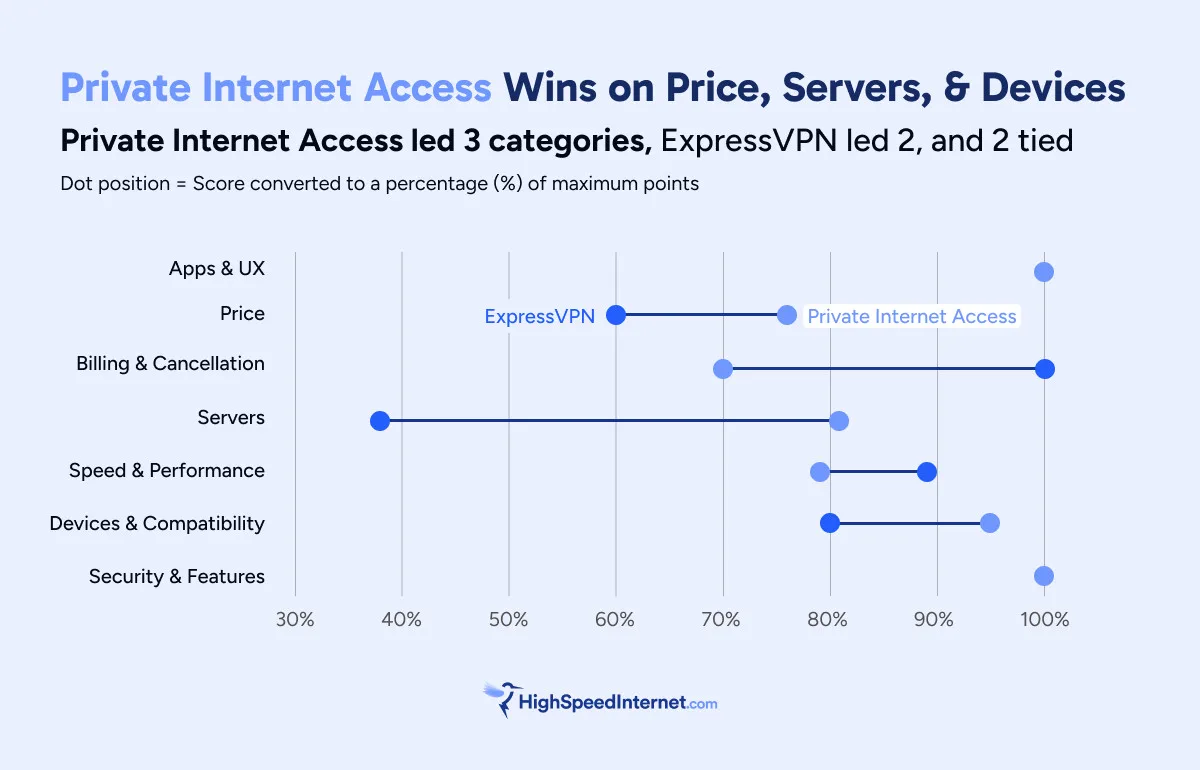
ExpressVPN is a strong pick if you want faster speeds, the easiest refund process around, or premium extras like identity theft insurance and a private AI tool. For everyone else, PIA gives you more VPN for less, without the upsells.
Private Internet Access vs. ExpressVPN: FAQ
Is PIA or ExpressVPN faster?
Which is cheaper, PIA or ExpressVPN?
Do PIA or ExpressVPN have a free plan?
Can I use PIA or ExpressVPN for streaming?
Disclaimers
Prices and plan offerings are accurate as of July 2026. We update VPN pricing data on a quarterly basis in order to compare providers fairly and to present stable pricing expectations. VPN services update prices frequently, so plans, prices, and offers may vary based on when you order.
ExpressVPN plans
ExpressVPN Basic — By clicking “Subscribe with Card” below, I agree to the Terms of Service — including the dispute resolution clause which requires binding arbitration for U.S. residents; the Privacy Policy; the Cancellation Policy; and the Automatic Renewal Terms set forth below. Automatic Renewal Terms: Your minimum initial purchase is $74.91 for 2 Years of VPN + 4 Months. Your subscription plan will automatically renew on an annual basis starting on 11/15/2028 at the rate of $99.95/year (plus vat/tax where applicable, and price subject to change with advance notice) to your selected payment method until you cancel, which you may do at any time before midnight on the autorenewal date by going to the “Subscription” tab and following the “Cancel” prompts.
ExpressVPN Advanced — By clicking “Subscribe with Card” below, I agree to the Terms of Service — including the dispute resolution clause which requires binding arbitration for U.S. residents; the Privacy Policy; the Cancellation Policy; and the Automatic Renewal Terms set forth below. Automatic Renewal Terms: Your minimum initial purchase is $89.96 for 2 Years of VPN + 4 Months. Your subscription plan will automatically renew on an annual basis starting on 11/15/2028 at the rate of $119.95/year (plus vat/tax where applicable, and price subject to change with advance notice) to your selected payment method until you cancel, which you may do at any time before midnight on the autorenewal date by going to the “Subscription” tab and following the “Cancel” prompts.
ExpressVPN Pro — By clicking “Subscribe with Card” below, I agree to the Terms of Service — including the dispute resolution clause which requires binding arbitration for U.S. residents; the Privacy Policy; the Cancellation Policy; and the Automatic Renewal Terms set forth below. Automatic Renewal Terms: Your minimum initial purchase is $165.18 for 2 Years of VPN + 4 Months. Your subscription plan will automatically renew on an annual basis starting on 11/15/2028 at the rate of $199.95/year (plus vat/tax where applicable, and price subject to change with advance notice) to your selected payment method until you cancel, which you may do at any time before midnight on the autorenewal date by going to the “Subscription” tab and following the “Cancel” prompts.
Private Internet Access plans
All plans — All amounts are shown in USD, and any discounts reflect a reduction based on the current monthly service pricing at $11.95 per month. The 30-day money-back guarantee is available to new subscribers only; for subscriptions purchased via third-party app stores (e.g., Apple App Store), refunds are subject to their respective terms and conditions.
Author -
Editor - Jessica Brooksby
Jessica loves bringing her passion for the written word and her love of tech into one space at HighSpeedInternet.com. She works with the team’s writers to revise strong, user-focused content so every reader can find the tech that works for them. Jessica has a bachelor’s degree in English from Utah Valley University and seven years of creative and editorial experience. Outside of work, she spends her time gaming, reading, painting, and buying an excessive amount of Legend of Zelda merchandise.
Related Posts