Proton VPN vs. Private Internet Access: Which VPN Is Better?
Nov 18, 2026 | Share 


Security, VPN Vs.


* Availability may vary by location, and prices are subject to change. See Proton VPN disclaimers | Private Internet Access disclaimers.
Compare Proton VPN and Private Internet Access head-to-head
Which VPN is better, Proton VPN or Private Internet Access? The easy answer for most is Proton because it has a free plan with unlimited data, faster speeds on nearby servers, and a smoother refund process. Private Internet Access (PIA) also makes a strong case, with a perfect security score, unlimited devices on one plan, and the bigger server network.
But you can read that anywhere. We actually tested both of these providers, and here’s how it nets out.
Overall, our research gives Proton VPN the nod in scoring, coming in at 87/100 to PIA’s 85/100. For more, check out our Proton VPN and Private Internet Access reviews. For the true head-to-head comparison, here’s how these two top-notch VPNs compare.
Proton VPN vs. Private Internet Access at a glance
| Proton VPN | Private Internet Access | |
|---|---|---|
| Overall score | 87/100 | 85/100 |
| Starting price | $2.99/mo. (VPN Plus) | $1.33/mo. (3-yr. plan) |
| Month-to-month price | $9.99/mo. | $11.95/mo. |
| Free plan | Yes, unlimited data | No |
| Servers | 20,588 in 148 countries | 29,000+ in 91 countries |
| Simultaneous devices | 10 (1 on Free) | Unlimited |
| Money-back guarantee | 30 days | 30 days (direct purchases only) |
| Company background | Launched 2017; Swiss headquarters | Launched 2010; Denver, Colorado headquarters; owned by Kape Technologies since 2019 |
Availability and speed may vary by location, and prices are subject to change. See disclaimers.
In this comparison:
Pricing | Speed and performance | Features | Security and privacy | Apps | Billing and cancellation | Final verdict | FAQ
In this comparison:
 Pricing: Proton VPN by a nose
This one is closer than you might think. Proton VPN wins on flexibility. It has a free plan with unlimited data, so you can try it before you pay a cent, and its month-to-month rate is cheaper than PIA’s.
PIA wins if you’re ready to commit. Its long-term plans cost less per month than Proton’s, and there’s only one plan, which includes every feature PIA offers and covers unlimited devices. The only decision you have to make is how long you want to sign up for.
One thing we liked about Proton: Our account clearly showed what we’d pay at renewal, so there were no surprises. Here are the plans you can choose from with each provider.
| Plan | Price range | Renewal rate | What's included |
|---|---|---|---|
| Proton Free | $0.00/mo. | N/A | |
| Proton VPN Plus | $2.99-$9.99/mo. | $83.88/yr. | |
| Proton Unlimited | $7.99-$12.99/mo. | $119.88/yr. | |
| PIA monthly | $2.03–$11.95/mo. | $11.95/mo. |
* Availability and speed may vary by location, and prices are subject to change. See disclaimers.
 Speed and performance: Proton VPN up close, PIA from afar
Proton VPN edged ahead on our speed score by less than a point, and it earned that lead on nearby servers. It kept more download speed than PIA and added less lag. But Proton took a big bite out of upload speeds, while PIA held onto most of its bandwidth in both directions. Here’s the speed breakdown so you can see why it was so close.
| Local server result | Proton VPN | PIA | Winner |
|---|---|---|---|
| Download speed | 867Mbps (-7.8%) | 732Mbps (-22.2%) | Proton VPN |
| Upload speed | 311Mbps (-67.2%) | 749Mbps (-21.0%) | PIA |
| Latency | 38.02 ms (+48%) | 50.28 ms (+96%) | Proton VPN |
| Jitter | 4.63 ms (+38%) | 7.61 ms (+126%) | Proton VPN |
A quick note on distant servers: On a far-off server, the tables turned. PIA added less lag and kept steadier connections, while Proton held onto a bit more download speed.
What does that mean for you? If you game or take video calls on nearby servers, Proton VPN will feel quicker. If you upload big files or connect to servers overseas, PIA is the better pick.
 Features: Proton VPN brings the extras, and PIA brings the control
Proton VPN and PIA have a lot of overlap. Both block ads and malware, offer a kill switch and multiple protocols, include a way to hide that you’re using a VPN, and help you get around age-verification and regional blocks. Both are open source, too, so anyone can check their code.
The differences come down to what each one adds on top. Proton leans into privacy routing and extras, with Secure Core, Tor over VPN, servers built for P2P and BitTorrent, port forwarding, dark web monitoring, and free access to Proton Pass, Mail, Calendar, and Drive. PIA leans into control over the VPN itself. You can choose between two encryption strengths, route traffic through two servers with multi-hop, use split tunneling that finds your apps for you, and turn on an advanced kill switch that blocks all traffic until the VPN is on.
The unique offerings won’t change how either VPN protects you day to day. If you want a broader privacy toolkit, go Proton. If you want to fine-tune your VPN or cover every device in the house, go PIA.
 Security and privacy: PIA by a hair
Let’s be clear: Both Proton VPN and PIA are safe choices when it comes to security and privacy. Each uses AES-256 encryption, publishes its code for anyone to inspect, and has a no-logs policy verified by independent audits.
What sets PIA slightly ahead is how far it takes transparency. Deloitte has confirmed its no-logs policy three times, and PIA lets anyone read the audit report, not just paying customers. It also runs RAM-only servers that can’t store your data long-term, and it lets you choose a lighter encryption setting when speed matters more.
Proton VPN has something you can’t put on a spec sheet: a record of saying no in court. It has denied every one of the 458 requests it’s received for identifying user information, including 121 legally binding orders in 2021. It’s based in Switzerland, outside the Five Eyes alliance, and was the first VPN to make the code for all its major apps public. If proven backbone matters most to you, that’s hard to beat.
 Apps: It’s a tie
Both apps earned a perfect score from us, and neither one bombards you with upsells. Proton VPN’s apps have a clickable server map, live server load, and icons that flag which servers handle streaming, P2P, or Tor, which makes them great for beginners. PIA’s app shows a live ping for every server, so you can spot the fastest connection at a glance, something Proton doesn’t offer.
 Billing and cancellation: Proton VPN is smoother
Both providers offer a 30-day money-back guarantee, and both honored it without a fight. The difference was speed. Proton VPN answered our refund request within an hour, while PIA took about a day to reply. Once PIA got back to us, though, the refund came quickly, and it didn’t even ask us for a reason. Proton also drops you to its free plan when you cancel, so you’re never left without a VPN. Check out the step-by-step breakdown for cancellation below.
| Proton VPN | PIA | |
|---|---|---|
| How to request a refund | Contact form or email | Support ticket or email |
| Our reviewer's experience | Reply within an hour, no issues | Reply in about 24 hours, no reason required |
| Refund timing | 1–10 days, depending on payment method | About 8 hours after confirming |
 Pro tip: Buy PIA directly from its website, since app store purchases don’t qualify for its money-back guarantee. With Proton, request your refund well before day 30, since it doesn’t offer 24/7 live support.
 Final verdict for Proton VPN vs. Private Internet Access: Proton VPN wins!
Yes, Proton VPN wins overall, but only by two points. It came out ahead on price, billing, servers, and speed, while PIA led on security and devices, and the two tied on apps. This is about as close as a head-to-head gets, so the right pick comes down to what matters most to you.
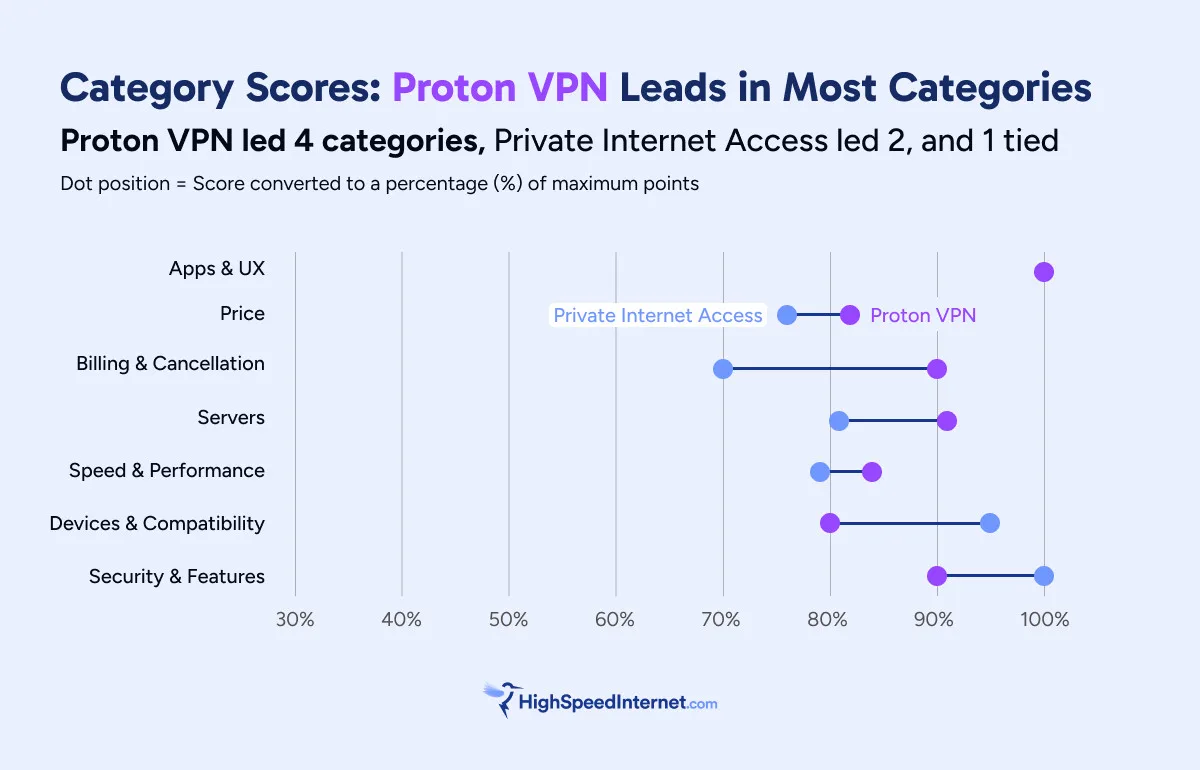
PIA is a strong pick if you want a perfect security score, unlimited devices, or the lowest long-term price. For everyone else, Proton VPN is the easier place to start, and you can try it free first.
Proton VPN vs. Private Internet Access: FAQ
Is Proton VPN or PIA faster?
Which is cheaper, Proton VPN or PIA?
Is Proton VPN's free plan any good?
Can I use Proton VPN or PIA for streaming?
Disclaimers
Prices and plan offerings are accurate as of July 2026. We update VPN pricing data on a quarterly basis in order to compare providers fairly and to present stable pricing expectations. VPN services update prices frequently, so plans, prices, and offers may vary based on when you order.
Private Internet Access plans
All plans — All amounts are shown in USD, and any discounts reflect a reduction based on the current monthly service pricing at $11.95 per month. The 30-day money-back guarantee is available to new subscribers only; for subscriptions purchased via third-party app stores (e.g., Apple App Store), refunds are subject to their respective terms and conditions.
ProtonVPN plans
VPN Plus — The specially discounted price of US$71.76 is valid for the first 24 months. Then it will automatically be renewed at US$83.88 for 12 months. You can cancel at any time. Renewal pricing subject to change according to terms and conditions.
Proton Unlimited — Your subscription will automatically renew. You'll then be billed every 12 months at US$119.88. You can cancel at any time. Renewal pricing subject to change according to terms and conditions.
Author -
Editor - Jessica Brooksby
Jessica loves bringing her passion for the written word and her love of tech into one space at HighSpeedInternet.com. She works with the team’s writers to revise strong, user-focused content so every reader can find the tech that works for them. Jessica has a bachelor’s degree in English from Utah Valley University and seven years of creative and editorial experience. Outside of work, she spends her time gaming, reading, painting, and buying an excessive amount of Legend of Zelda merchandise.
Related Posts