Norton VPN vs. CyberGhost: Which VPN Is Better?
Nov 19, 2026 | Share 


Security, VPN Vs.
* Availability may vary by location, and prices are subject to change. See Norton VPN disclaimers | CyberGhost disclaimers.
Compare Norton VPN and CyberGhost head-to-head
Which VPN is better, Norton VPN or CyberGhost? The easy answer for most is CyberGhost because it’s faster, runs a server network more than five times the size, offers month-to-month plans, and never raises its prices. Norton VPN also makes a strong case, with family-friendly tools, coverage for up to 20 devices, and a generous 60-day refund window.
But you can read that anywhere. We actually tested both of these providers, and here’s how it nets out.
Overall, our research gives CyberGhost the nod in scoring, coming in at 85/100 to Norton VPN’s 76.1/100. For more, check out our Norton VPN and CyberGhost reviews. For the true head-to-head comparison, here’s how these two top-notch VPNs compare.
Norton VPN vs. CyberGhost at a glance
| Norton VPN | CyberGhost | |
|---|---|---|
| Overall score | 76.1/100 | 85/100 |
| Starting price | $3.33/mo. | $1.59/mo. |
| Month-to-month price | Not offered (annual plans only) | $12.99/mo. |
| Free plan | No | No |
| Servers | 2,000+ in 90+ countries | 11,500+ in 100 countries |
| Simultaneous devices | 10–20 | 7 |
| Money-back guarantee | 60 days | 45 days (14 days on monthly plans) |
| Company background | Norton brand founded 1982; VPN launched 2019; Tempe, Arizona, headquarters (parent company Gen Digital) | Launched 2011; Bucharest, Romania headquarters; owned by Kape Technologies since 2017 |
In this comparison:
Pricing | Speed and performance | Features | Security and privacy | Apps | Billing and cancellation | Final verdict | FAQ
In this comparison:
 Pricing: A near tie
Our price scores were nearly identical, and each VPN wins on something different. CyberGhost has a lower starting rate, lets you pay month to month, and includes every feature in every plan. Better yet, our CyberGhost reviewer has used the service for seven years and has never seen a price hike.
Norton doesn’t sell monthly plans at all, so you’ll need to commit to at least a year. In exchange, you get premium privacy tools like double VPN and a rotating IP on its entry-level plan, a longer 60-day refund window, and an email with your renewal price before you’re charged. Its higher tiers also bundle extras CyberGhost doesn’t offer, like a password manager, cloud storage, and parental controls.
Here are the renewal rates you can expect if you commit to either of them.
| Plan | Price range | Renewal rate | What's included |
|---|---|---|---|
| Norton Standard | $3.33/mo. | Disclosed by email before renewal | |
| Norton Plus | $4.17/mo. | Disclosed by email before renewal | |
| Norton Ultimate | $5/mo. | Disclosed by email before renewal | |
| CyberGhost | $1.59–$12.99/mo. | $12.99/mo. |
* Availability and speed may vary by location, and prices are subject to change. See disclaimers.
 Speed and performance: CyberGhost pulls ahead
These are two of the fastest VPNs we’ve tested, and both felt seamless in daily use. But CyberGhost beat Norton on every measurement on a nearby server, keeping more bandwidth and adding even less lag. That makes it the stronger pick for fast-paced gaming, where every millisecond counts. Here’s the speed breakdown so you can see why.
| Local server result | Norton VPN | CyberGhost | Winner |
|---|---|---|---|
| Download speed | 872Mbps (-7.2%) | 887Mbps (-5.6%) | CyberGhost |
| Upload speed | 848Mbps (-10.6%) | 885Mbps (-6.6%) | CyberGhost |
| Latency | 45.3 ms (+76.5%) | 33.15 ms (+29%) | CyberGhost |
| Jitter | 10.1 ms (+200.6%) | 5.1 ms (+52%) | CyberGhost |
A quick note on distant servers: On a far-off server, CyberGhost held up better too, with faster downloads and less lag, while Norton kept a bit more upload speed.
What does that mean for you? You’ll be happy with either one for streaming, browsing, and video calls. If you play fast-paced online games or connect to servers overseas, CyberGhost has the edge.
 Features: Norton builds for families, CyberGhost perfects the VPN
Norton VPN and CyberGhost have a lot of overlap. Both offer a kill switch, ad and malware blocking, multiple protocols, servers for torrenting, and help getting around age-verification and regional blocks. They share the same weakness: Split tunneling is limited on both. Norton’s works only for apps on Windows and not at all on iPhone, and CyberGhost’s works only for websites on computers.
Where they split is who they’re built for. Norton is built for families. Every plan includes double VPN and an IP address that rotates automatically, and its higher tiers add dark web monitoring, a password manager, cloud storage, parental controls, phone location tracking, and coverage for up to 20 devices.
CyberGhost stays focused on making the VPN itself easy and fast, with every feature on every plan. That includes servers built for specific streaming services and gaming, extra-private NoSpy servers, and Privacy Guard, which tightens the privacy settings on your computer and browsers. It also works with just about anything, from Roku to PlayStation, Xbox, and Nintendo Switch, though it only covers seven devices at once.
The unique offerings won’t change how either VPN protects you day to day. If you want to keep the whole family covered, go Norton. If you want a fast, no-nonsense VPN that’s ready for streaming and gaming, go CyberGhost.
 Security and privacy: It’s a tie
Let’s be clear: Both Norton VPN and CyberGhost are safe choices, and both earned the same security score from us. Each uses AES-256 encryption and has a no-logs policy verified by third-party audits. Both are also part of bigger companies: Norton belongs to Gen Digital, and CyberGhost has been owned by Kape Technologies since 2017.
Norton VPN’s strength is openness about its own mistakes. Its most recent audit, by VerSprite in 2025, turned up a privacy discrepancy, and Norton fixed it, had the fix verified, and published the whole report for anyone to read. It also spells out exactly what data it collects, why, and how long it keeps it, and the brand has been in cybersecurity for over 40 years.
CyberGhost’s strength is consistency. Our reviewer has relied on it every day for seven years without a hitch, and its RAM-only servers make keeping logs impossible. Deloitte has confirmed its no-logs policy three times, most recently in 2025.
 Apps: It’s a tie
Both apps earned a perfect score from us, and both are refreshingly free of marketing clutter. Norton keeps things as simple as possible, with a big connect button, a notification whenever the VPN turns off, and key settings like split tunneling and the kill switch right up front.
CyberGhost puts everything a click or two away, uses a bright yellow button and tray icon to show at a glance when you’re protected, and lets you sort servers by distance. Neither shows a ping for every server, though CyberGhost does for its gaming servers.
 Billing and cancellation: It’s a tie
Both providers earned a perfect billing score, and both handled our refund requests in under five minutes. Norton’s chatbot did the whole thing, though it tried to keep us around with a couple of discount offers first.
CyberGhost has a dedicated cancel button on your subscription page, and its 24/7 live chat agent asked a couple of questions before starting the refund.
Norton gives you the longest window to change your mind, at 60 days, while CyberGhost gives you 45 days on plans of six months or more. Check out the step-by-step breakdown for cancellation below.
| Norton VPN | CyberGhost | |
|---|---|---|
| How to request a refund | Chatbot | 24/7 live chat, email, or support ticket |
| Our reviewer's experience | Done in under five minutes, despite two discount offers | A few retention questions, no issues |
| Refund timing | 5–7 business days | Started in less than five minutes |
 Pro tip: Canceling your Norton subscription in your account doesn’t get your money back, so request your refund separately through its chatbot. With CyberGhost, choose the six-month or two-year plan for the full 45 days, since the monthly plan only gives you 14.
 Final verdict for Norton VPN vs. CyberGhost: CyberGhost wins!
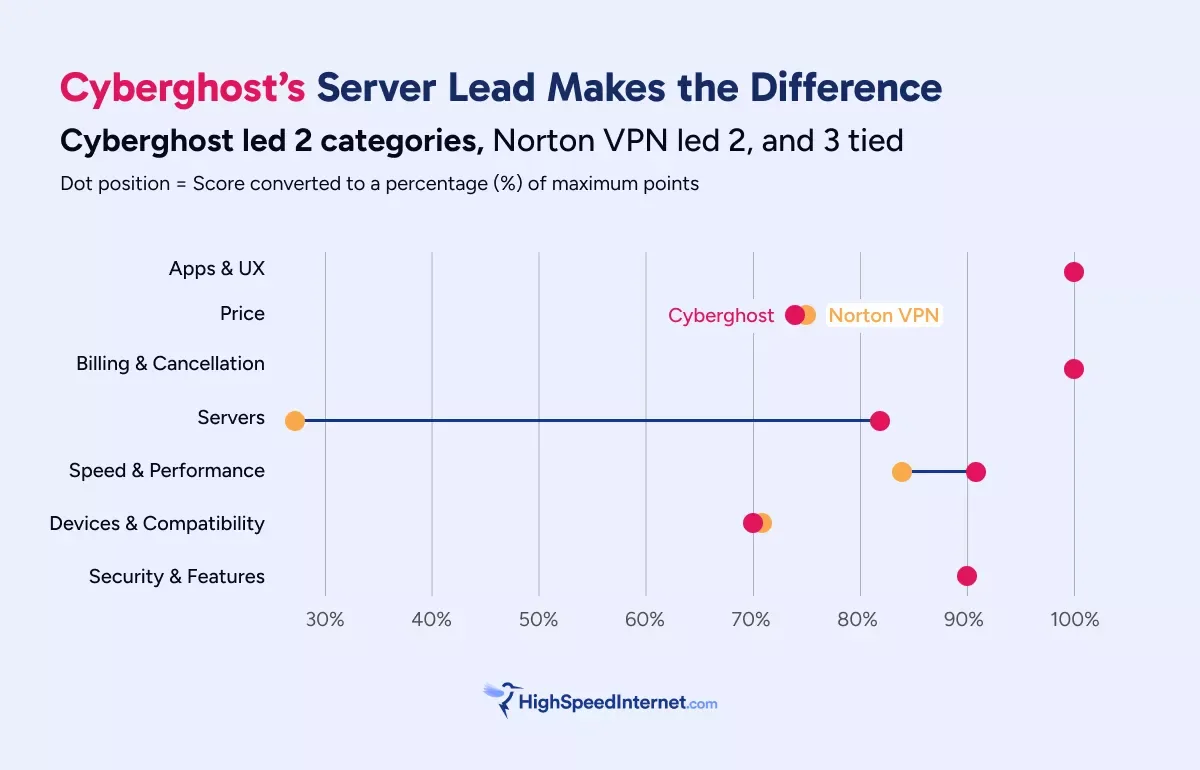
Yes, CyberGhost wins overall, 85/100 to 76.1/100. Most categories were close or tied, but CyberGhost’s massive server network outscored Norton’s by a wide margin, and it pulled ahead on speed too. Norton held slim leads on price and devices, and the two tied on billing, security, and apps.
Norton VPN is a strong pick if you want the longest refund window, coverage for up to 20 devices, or parental controls and everyday security tools in one subscription. For everyone else, CyberGhost gives you a faster VPN with far more servers, the flexibility to pay month to month, and a price that doesn’t creep up on you.
Norton VPN vs. CyberGhost: FAQ
Is Norton VPN or CyberGhost faster?
Which is cheaper, Norton VPN or CyberGhost?
Do Norton VPN or CyberGhost have a free plan?
Can I use Norton VPN or CyberGhost for streaming?
Disclaimers
Prices and plan offerings are accurate as of July 2026. We update VPN pricing data on a quarterly basis in order to compare providers fairly and to present stable pricing expectations. VPN services update prices frequently, so plans, prices, and offers may vary based on when you order.
CyberGhost plans
All plans – All amounts shown are in US Dollars. Taxes may apply based on your jurisdiction. Any discounts reflect a reduction based on the current monthly servicing pricing at $12.99 per month.
Norton VPN plans
All plans — Subscription contracts begin when the transaction is complete and are subject to our Terms of Sale and License & Services Agreement. For trials, a payment method is required at sign-up and will be charged at the end of the trial period, unless cancelled first. Subscriptions automatically renew unless the renewal is canceled before billing. Renewal payments are billed annually (up to 35 days before renewal) or monthly depending on your billing cycle. Annual subscribers will receive an email with the renewal price beforehand. Renewal prices may be higher than the initial price and are subject to change. You can cancel the renewal as described here in your account or by contacting us here or at 844-488-4540.
Author -
Editor - Jessica Brooksby
Jessica loves bringing her passion for the written word and her love of tech into one space at HighSpeedInternet.com. She works with the team’s writers to revise strong, user-focused content so every reader can find the tech that works for them. Jessica has a bachelor’s degree in English from Utah Valley University and seven years of creative and editorial experience. Outside of work, she spends her time gaming, reading, painting, and buying an excessive amount of Legend of Zelda merchandise.
Related Posts