2026 State of Online Privacy
Americans are more worried about online privacy than ever
Nov 17, 2026 | Share 


Data and Research, Trends
We live in an unprecedented internet era, with AI on the rise and hackers and scams gaining more sophistication. So it’s unsurprising that in a recent HighSpeedInternet.com survey, 84% of Americans said they worry about their online privacy, while 74% are more concerned about their online safety and privacy than they were a year ago.
That’s not all. Americans not only feel unsafe online—they also feel helpless. 27% of Americans indicated that they weren’t confident that they could spot a spam message, and approximately 86% said they lacked control over their online personal data.
How worried are people about their online safety and privacy?
| Statement | Yes | No |
|---|---|---|
| I am concerned about my safety and privacy online | 83.88% | 16.12% |
| I am more concerned about my online safety and privacy than I was a year ago | 74.21% | 25.79% |
How confident are people in spotting a scam message or call?
| Answer | Response percentages |
|---|---|
| Yes | 73.20% |
| No | 26.80% |
How much control do people feel they have over their data?
| Answer | Response percentages |
|---|---|
| Yes | 14.25% |
| No | 85.75% |
What worries Americans most about their online privacy?
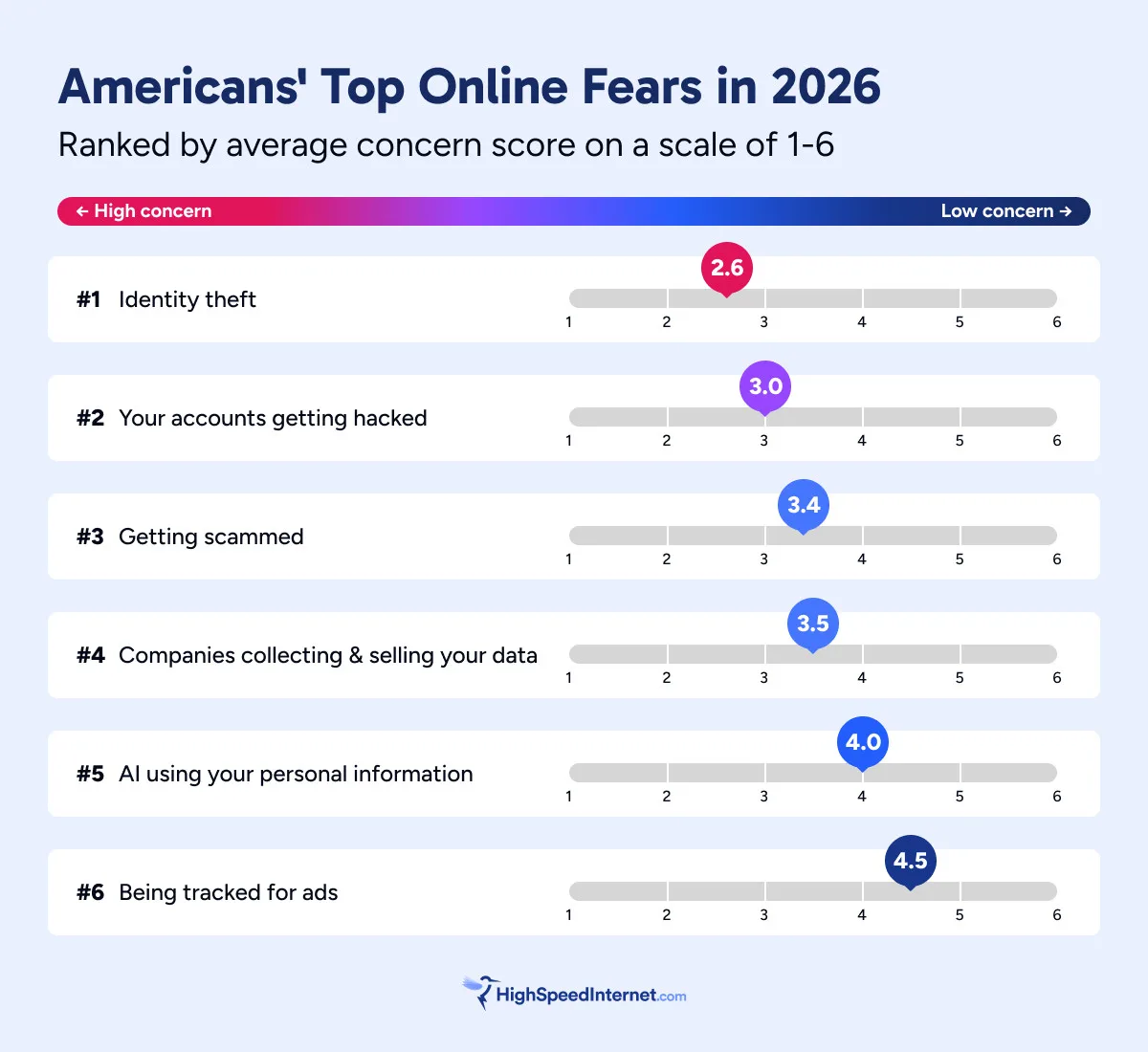
Americans have a lot of online privacy concerns, including:
- Their identities being stolen
- Their accounts getting hacked
- Being scammed
- Companies collecting and selling their data
- AI using their personal information
- Being tracked for ads
Understandably, the top fear is a stolen identity, a crime that can ruin someone’s credit, finances, and life. Being tracked for ads, an often benign and occasionally helpful co-option of personal data, comes in last.
How often do scams and data breaches actually happen to Americans?
Scams and data breaches are well-founded fears. Our survey data shows that 60% of Americans encountered a scam attempt in the past year, while 50% received a notification about a data breach.
How many people have experienced a scam, breach, or hack in the past year?
| Statement | Yes |
|---|---|
| Someone tried to scam you by email, text, phone, or online | 60.46% |
| You were told your personal information was in a data breach | 50.27% |
| One of your online accounts was hacked or accessed without permission | 20.05% |
Additionally, most Americans indicated that someone they know has lost money in a scam.
How many people have lost money to a scam?
| Answer | Response percentages |
|---|---|
| Yes, myself | 11.22% |
| Yes, someone I know | 31.69% |
| No | 57.09% |
What do Americans do after a breach or scare?
After a breach, Americans are often spurred to take action. Roughly 77% change their passwords, while about a third sign up for identity or credit monitoring or freeze their credit. In some ways, these actions are like shutting the barn after the horses are gone, but they can sometimes be helpful.
Top actions after a data breach or security scare
| Rank | Statement | Yes |
|---|---|---|
| 1 | Changed passwords | 76.81% |
| 2 | Signed up for identity or credit monitoring | 33.89% |
| 3 | Frozecredit | 31.19% |
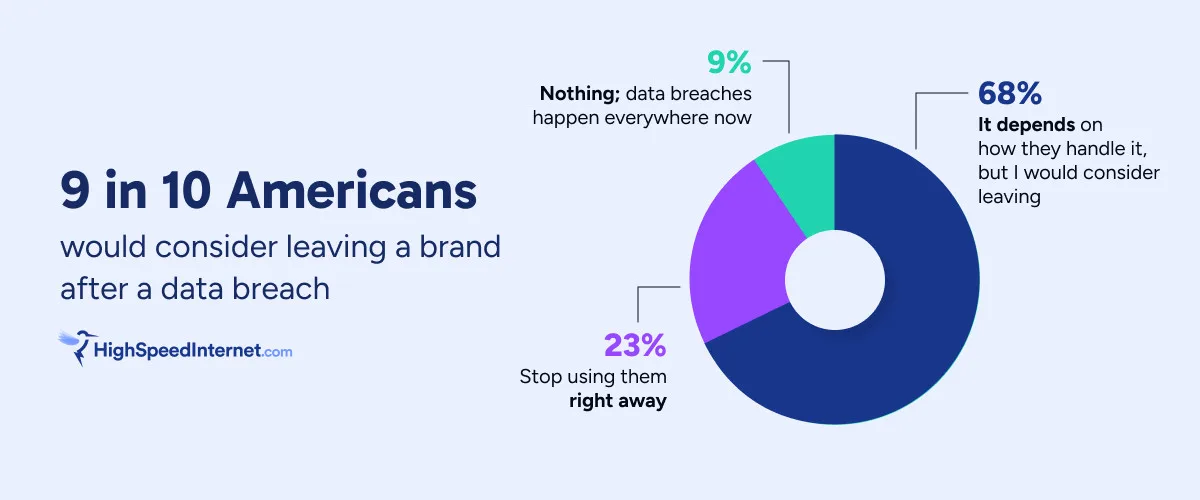
But that’s not all. 91% of survey respondents said they would consider leaving a brand that had experienced a major data breach. Pair this with the earlier stat—that about 50% of Americans have experienced a data breach—and it’s clear that brands need to take action to better protect customer data.
How they respond can make a big difference too. 67.81% of survey respondents said whether they’d leave after a data breach depends heavily on the brand’s response.
What data can internet providers see?
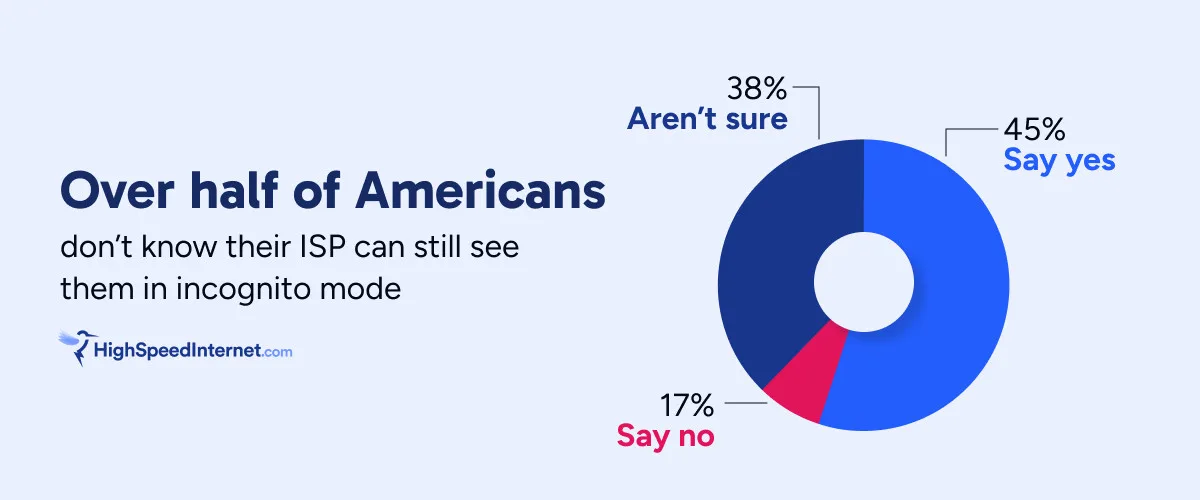
One of the most surprising findings from our survey was that only 46% of Americans know that their internet providers can still see what they do when their browser’s in incognito mode.
Incognito modes keep browsers from storing data about activity after use—a feature that’s particularly useful on a shared device. But they don’t keep browsers from seeing users’ actions in real-time, and most importantly, they don’t prevent an internet service provider (ISP) from seeing the domains their customers visit or (legally) throttling their speeds if those customers engage in certain unsavory activities.
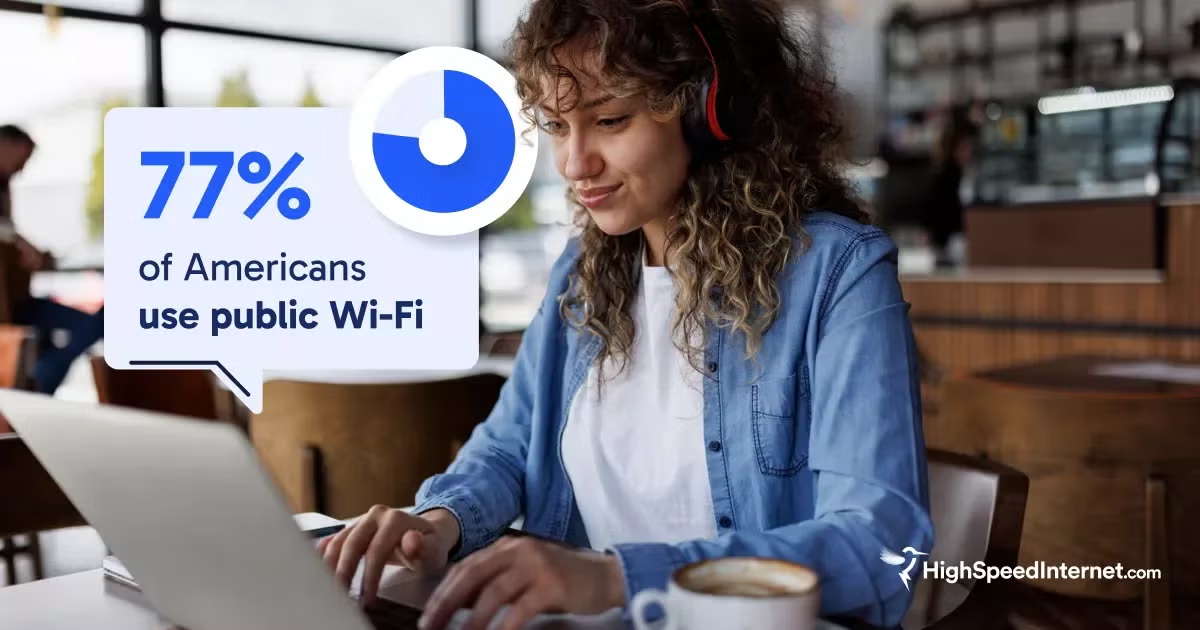
To keep online activities shielded from their ISPs, internet users would have to invest in a virtual private network (VPN). And VPNs are also a great way to protect data when using public Wi-Fi. But according to our survey, just 30% of Americans use VPNs. About half (55%) indicated that cost keeps them from using more internet privacy tools, while 31% said they don’t know how to use them.
How many people who use protection tools also use a VPN?
| Answer | Response percentages |
|---|---|
| Yes, I use one now | 82.20% |
| No, but I used one in the last year or two | 17.80% |
| No, and I have never used one | 0.00% |
How do Americans protect themselves online?
The American privacy protection game is pretty strong. Roughly three-fourths of respondents reported using two-factor authentication, unique passwords, and secure Wi-Fi passwords, while roughly half said they use password managers and antivirus software. All of those are great ways to keep information safe, especially when combined.
What privacy habits do people practice?
| Statement | Yes | No | Not sure |
|---|---|---|---|
| Use two-factor authentication on your important accounts | 76.77% | 17.89% | 5.34% |
| Use a different password for each of your important accounts | 72.99% | 20.00% | 7.01% |
| Know how to create a secure Wi-Fi password | 70.00% | 20.87% | 9.13% |
| Use a password manager | 38.33% | 55.06% | 6.61% |
| Change your home Wi-Fi password in the past year | 30.74% | 62.55% | 6.70% |
But there are also some surprising gaps. Almost 63% haven’t changed their Wi-Fi password in the last year, and 46% use no antivirus protection.
Which online protection tools do people use?
| Answer | Yes | No |
|---|---|---|
| Two-factor authentication | 82.05% | 17.95% |
| Antivirus | 54.05% | 45.95% |
| A password manager | 44.62% | 55.38% |
| Private or incognito browsing | 40.00% | 60.00% |
| Ad or tracker blocker | 36.43% | 63.57% |
| Identity or credit monitoring | 32.35% | 67.65% |
| A VPN | 30.82% | 69.18% |
| None of the above | 3.38% | 96.62% |
What keeps people from using more online protection tools?
| Answer | Response percentages |
|---|---|
| Cost | 54.74% |
| Too complicated | 30.82% |
| Never thought about it | 18.55% |
| Don't think I need them | 17.78% |
| Nothing; I use what I need | 15.25% |
| Worried they'll slow things down | 12.91% |
Do people use privacy tools to keep AI companies from collecting their data?
| Answer | Response percentages |
|---|---|
| I've thought about it, but don't know how | 50.52% |
| Yes, I actively do this | 27.51% |
| No, I don't see the need | 21.97% |
Who do Americans trust with their data, and would they pay for better privacy?
In a predictably American response, 72.83% of Americans said they don’t trust or aren’t sure if they trust either big tech companies or their own ISPs to handle their personal data responsibly.
Who do people trust more with their personal data?
| Answer | Response percentages |
|---|---|
| Neither | 58.74% |
| My internet provider | 22.28% |
| Not sure | 14.09% |
| Big tech companies | 4.89% |
Meanwhile, 45% are willing to pay more for services with better privacy guarantees from those same internet providers or other companies, despite the lack of trust.
Would people pay more for better online privacy?
| Answer | Response percentages |
|---|---|
| Yes | 45.38% |
| Not sure | 30.29% |
| No | 24.32% |
In the end, Americans feel desperate and just want something that works. 25% have given up protecting their data, while 50% want to protect it but find it too difficult. Anything that helps them feel control over their own data would likely be welcome, whatever the source.
How do people feel about online privacy right now?
| Answer | Response percentages |
|---|---|
| I want to protect my privacy, but it takes too much effort or breaks the sites I use | 50.33% |
| I've largely given up; companies will get my data no matter what I do | 25.47% |
| I actively research and buy tools to keep my data secure | 18.49% |
| I'm not worried about online data collection | 5.72% |
Methodology
HighSpeedInternet.com surveyed 1,000 U.S. adults online via Pollfish on Sept. 18, 2026. To accurately represent the nation, we stratified the results to match the U.S. Census data for age, gender, and region. In the survey, we asked respondents about their online privacy concerns, scam experiences, account security habits, and what people think internet providers can see.
Author -
Editor - Jessica Brooksby
Jessica loves bringing her passion for the written word and her love of tech into one space at HighSpeedInternet.com. She works with the team’s writers to revise strong, user-focused content so every reader can find the tech that works for them. Jessica has a bachelor’s degree in English from Utah Valley University and seven years of creative and editorial experience. Outside of work, she spends her time gaming, reading, painting, and buying an excessive amount of Legend of Zelda merchandise.
Related Posts